
Quick answer
The dryer vent problems that go beyond routine lint are a blocked exterior hood (often a bird nest), a vent run too long or bendy for good airflow, and an unsafe foil or plastic transition hose behind the machine. Each has a specific fix: clearing and guarding the hood, evaluating the run, or replacing the hose with semi-rigid metal. All three show up first as clothes that will not dry on one cycle.
Dryer Vent · Problems & Parts
Beyond routine lint, several dryer vent problems hurt performance and safety: bird or pest nests blocking the exterior vent, vent runs that are too long for proper airflow, missing booster fans, and unsafe foil or plastic transition hoses. Here’s how to spot and fix each.
Reviewed by the Prestige Protected Team · Updated August 2026 · Cary, Raleigh & the NC Triangle
Bird and pest nests in the vent
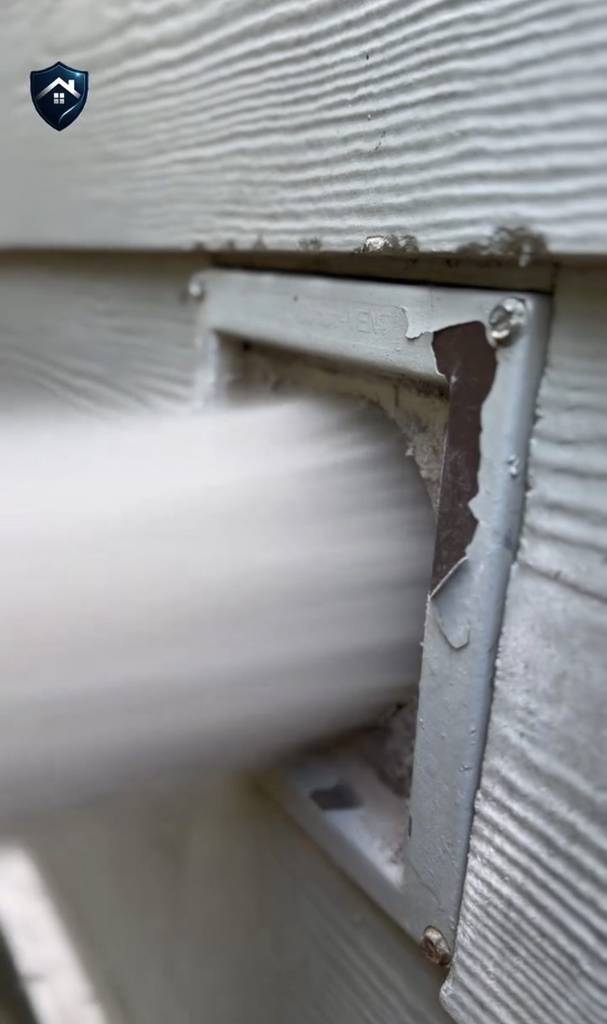
The exterior vent flap is a favorite nesting spot for birds and small animals, especially if the damper sticks open. A nest blocks airflow completely. Clothes will not dry, and lint backs up. We remove the blockage and recommend a proper vent cover/guard that still allows the flap to operate.
Rooftop and second-floor vents
Vents that exit through the roof or an upper floor need ladders and specialized tools to clean safely, a job better left to a pro. These runs also clog more easily, so they benefit from regular cleaning.
Can I put a screen over the vent to keep birds out?
Please do not. A mesh screen stops birds for one season and then becomes a lint filter on the outside of your house, in the one place nobody thinks to inspect. We remove more blocked screens than we do nests. The right product is a vent guard with widely spaced bars or a hinged flap hood that lint can pass through, and the right habit is a look at the termination each spring.
Why does my dryer stop before the clothes are dry?
Many machines have a thermal cut-out that trips when the appliance overheats, and a restricted duct is the most common reason it overheats. So a dryer that shuts down mid-cycle, or finishes with damp clothes, is often reporting a duct problem rather than an appliance fault. Check the exterior hood while a load runs before you call an appliance technician, because a restricted vent will also shorten the life of the machine.
Are indoor dryer vent kits safe?
For a gas dryer, never: combustion products must be vented outdoors, full stop. For an electric dryer, an indoor lint trap kit is legal in some situations and still a poor idea, because it discharges the moisture from every load into your living space along with the fine lint the trap does not catch. In a humid climate like ours that is a mold risk you are creating deliberately. Venting outdoors is the answer.
How long should a normal dryer cycle take?
Roughly 40 minutes for an average load on a healthy vent. Sixty is worth watching. Ninety, or a load that needs a second run, means something is restricting the airflow, and the duct is more often the culprit than the machine. The trend matters more than the absolute number: if your dryer used to take 45 minutes and now takes 75, that change is the diagnosis.
Do dryer sheets cause vent problems?
They contribute at the lint screen rather than in the duct. The residue can build into a film on the mesh that restricts airflow while still looking clean, which is why it is worth washing the screen in warm soapy water with a soft brush a couple of times a year. Hold it under a running tap: if water pools rather than passing straight through, it needs the wash. It is not a reason to skip the annual cleaning of the run itself.
Is a landlord required to clean the dryer vent?
We are not lawyers and this is not legal advice, so treat it as practical guidance. In practice, responsibility usually depends on the lease and on who owns the appliance, and most managing agents treat vent cleaning as building maintenance rather than tenant upkeep. We work for plenty of landlords and property managers in the Triangle, and the sensible arrangement we see most often is a scheduled cleaning between tenancies with the report kept on file.
Talk to a Triangle specialist
FAQ & related
If you are in the Triangle and want one of these looked at, see Cary or Raleigh dryer vent cleaning.
Frequently asked questions
How do I know if a bird is nesting in my dryer vent?
Drying suddenly takes much longer, you hear sounds near the vent, or the exterior flap won’t close. We remove nests and install a proper guard.
Source: 2024 International Residential Code, Chapter 15, Section M1502, clothes dryer exhaust.
Related guides
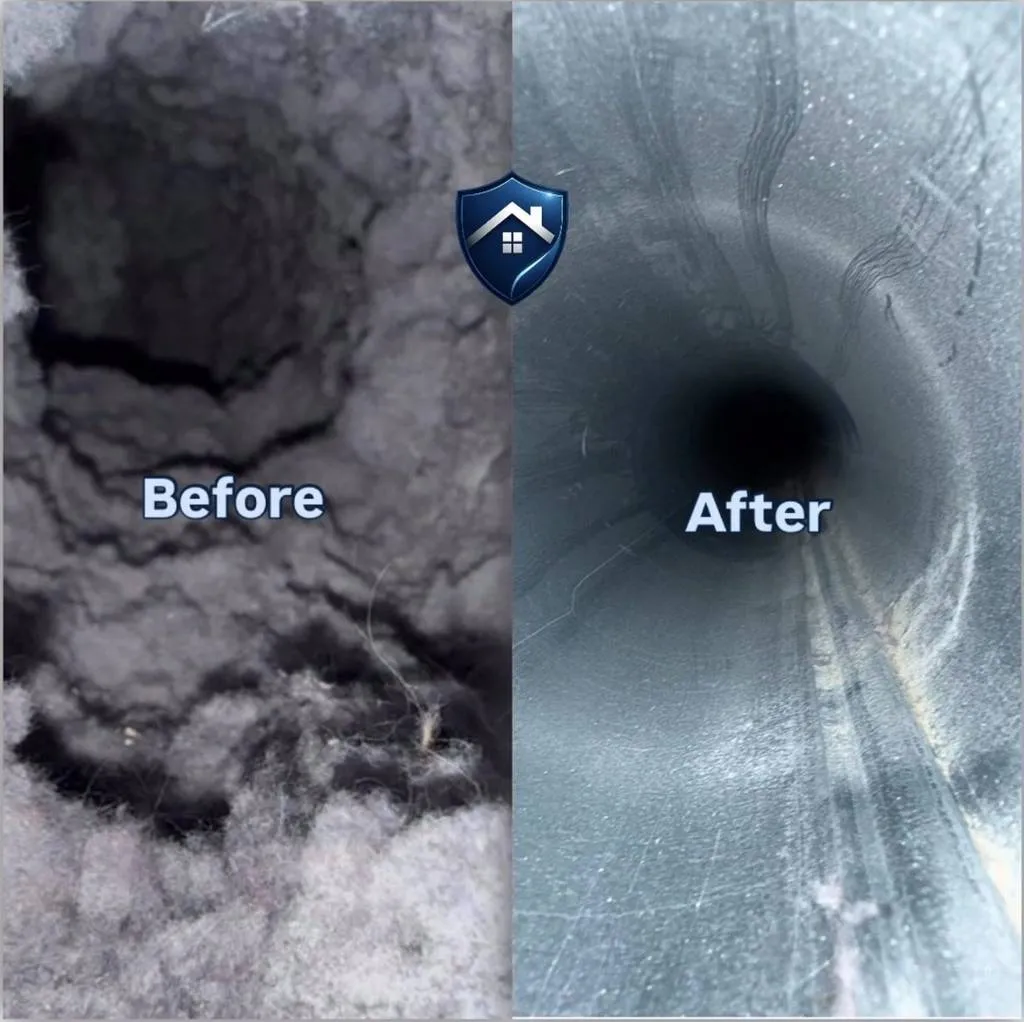
Most dryer vent complaints are not a lint blockage. They are a design or installation fault that produces the same symptom, which is why the vent gets cleaned, behaves for a few months, and then goes back to taking two cycles.
The seven faults we find most often, in order
This is what actually turns up on Triangle jobs, roughly by frequency. Only the first is fixed by cleaning alone.
- An ordinary lint load in a sound duct. The straightforward case, and the reason annual cleaning exists.
- A foil or plastic transition hose behind the machine. Ribbed, combustible, and usually crushed flat by a dryer pushed back against the wall.
- A run longer than the dryer can push against. Common in two-story homes with the laundry upstairs.
- A screen or mesh across the exterior hood. Added to keep birds out, and now a lint filter that nobody inspects.
- Screws at the joints. Every projecting screw point starts a lint deposit inside the duct.
- A bird or rodent nest at the termination. Spring problem, and a nest can block a four-inch duct almost completely.
- A separated joint inside the structure. The serious one, covered in full on our page about a dryer vent disconnected in the attic.
Why a long run behaves exactly like a blocked one
A dryer has a fixed amount of push. Past a certain length, air slows enough that lint settles instead of traveling, so a long run does not merely underperform. It actively builds the blockage that finishes it off.
The International Residential Code puts the limit at a maximum developed length of 35 feet from the transition duct connection to the outlet terminal, with 5 feet deducted for each 90-degree bend and 2 feet 6 inches for each 45-degree bend. If the appliance instructions specify less, that figure governs instead.
Do the sum on your own house. Pace the run, count the elbows, subtract. Thirty feet with two 90s and one 45 comes out at 42 feet 6 inches of developed length, which is over the limit before a single piece of lint has landed. If yours is over, cleaning is maintenance rather than a fix, and the real options are shortening the route, moving the termination, or in some cases a properly installed booster fan. Our rerouting guide covers what is usually possible.
The transition hose: what is actually allowed
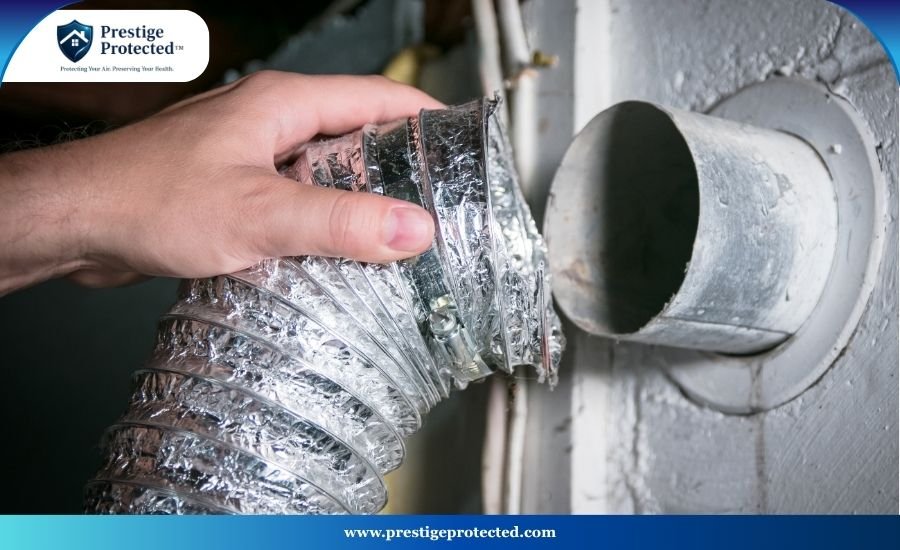
The flexible piece between the machine and the wall is the part homeowners can inspect in two minutes, and it is the part that most often fails the standard. The code expects it to be listed to UL 2158A, limited to a single length of no more than 8 feet, and not concealed within construction.
- White plastic or vinyl. Replace it. It is combustible and it is not permitted for this use.
- Thin foil accordion. The most common item we remove. The ribs hold lint, it sags into a low point, and it crushes flat behind the machine.
- Semi-rigid aluminum. Acceptable when it is a listed product, kept short and not crushed. This is the practical choice for most laundry rooms.
- Rigid metal. The best performer, and worth it wherever the geometry allows a fixed connection.
- Anything run through a wall, floor or ceiling. Wrong regardless of material. A transition duct is not permitted to be concealed within construction, and concealed flexible hose is the fault we least like finding.
Reading the exterior hood from the ground
You can diagnose a surprising amount from the driveway with the dryer running. This is the check we ask people to do before booking.
- Flap wide open with strong warm airflow. Healthy.
- Flap barely lifting. Restricted somewhere along the run.
- Flap not moving at all. Blocked, or the duct has come apart inside the house and is discharging somewhere it should not be.
- Lint visible on the siding around the hood. The system is working but the volume is high, so it is due.
- Mesh or a screen across the opening. A blockage in progress. Ask for a guard with widely spaced bars instead.
- Flap stuck open, or missing. Outside air, insects and pests have a route in, and the backdraft damper is not doing its job.
The safety numbers, without the drama
The U.S. Fire Administration reports that failure to clean is the leading factor contributing to the ignition of home clothes dryer fires, accounting for 31 percent of them. That is the whole argument, and it does not need embellishing. Lint is fuel, restriction keeps the appliance hot, and the two together account for most of it.
There is a moisture argument alongside the fire one. Every load carries several pounds of water out of your clothes, and a duct that is restricted or apart puts that water into the building instead of outside. The EPA notes that water-damaged areas and items should be dried within 24 to 48 hours to prevent mold growth, which is why a long-running vent fault often presents as a smell rather than as a fire risk.
If your dryer is gas, a blocked duct also has combustion products with nowhere to go, so treat a suspected blockage on a gas appliance as a stop-using-it situation rather than a weekend job.
A maintenance rhythm that suits a Triangle home
- Every load: clear the lint screen. It takes five seconds and it is the highest-value habit in the whole list.
- Monthly: pull the dryer out far enough to check the hose is not crushed, and glance at the exterior hood while a load runs.
- Every spring: check the termination for nesting, because that is when it happens here.
- Annually: a professional cleaning of the full run for an average household. Every six months for long runs, big families, or heavy-shedding pets.
- Whenever drying time changes: treat it as the signal it is, rather than waiting for the calendar. Our guide to slow drying works through the causes in order.
- After any work in the attic or crawlspace: check the run. HVAC, insulation, cable and roofing work are the usual reasons a joint ends up separated.
We cover Raleigh, Cary and the surrounding Triangle for both cleaning and vent repair, so the recommendation you get is based on what the camera shows rather than on which service we happen to sell.
Last updated by the Prestige Protected service team.
Common questions
Are booster fans a good fix for a long vent run?
Sometimes, but only when the run genuinely exceeds what the dryer can push (once the elbow deductions are counted against the 35-foot limit) and rerouting is impractical. A booster on a merely dirty line masks the problem and adds a maintenance point. Clean and measure first.
Is a foil transition hose actually dangerous?
It is the weakest link in most installations. Thin foil crushes when the dryer is pushed back against the wall, and its ridges trap lint right where the exhaust is hottest. Semi-rigid aluminum costs little more and removes that failure mode. Replacing it is one of the highest-value small fixes in dryer safety.