Buyer’s Guide · Choosing a Company
TL;DR (quick answer): Choose a company that inspects before it quotes, gives you upfront written pricing, cleans the whole system (not just the registers you can see), and can show you before-and-after photos of real jobs. Steer clear of “$99 whole-house” blow-and-go ads, they are the classic bait for high-pressure upsells.
Air duct cleaning is one of those services where the gap between a good job and a bad one is huge, and it is hard to judge from the driveway. Use this checklist to separate the professionals from the “$99 special” crews before you let anyone touch your system.
By the Prestige Protected Team · Updated August 2026 · Cary, Raleigh & the NC Triangle
Red flags to walk away from
- “$99 whole-house” ads: the price that gets them in the door, followed by pressure to pay far more once they’re inside
- No inspection before a price: a real quote depends on system size, vent count and access
- Scare tactics: claiming they found “dangerous mold” on the spot and demanding you decide immediately
- Vague scope: won’t say in writing what is and isn’t included
- No proof of work: can’t show before-and-after photos or explain their method
For the full anatomy of the cheap-ad scam, see our guide on air duct cleaning scams to avoid.
Green flags to look for
- Inspects the system and gives written, upfront pricing before starting
- Explains the method, source removal with negative-air equipment, not just a shop vac at the register
- Cleans the whole system: supplies, returns, main trunk lines and the blower area
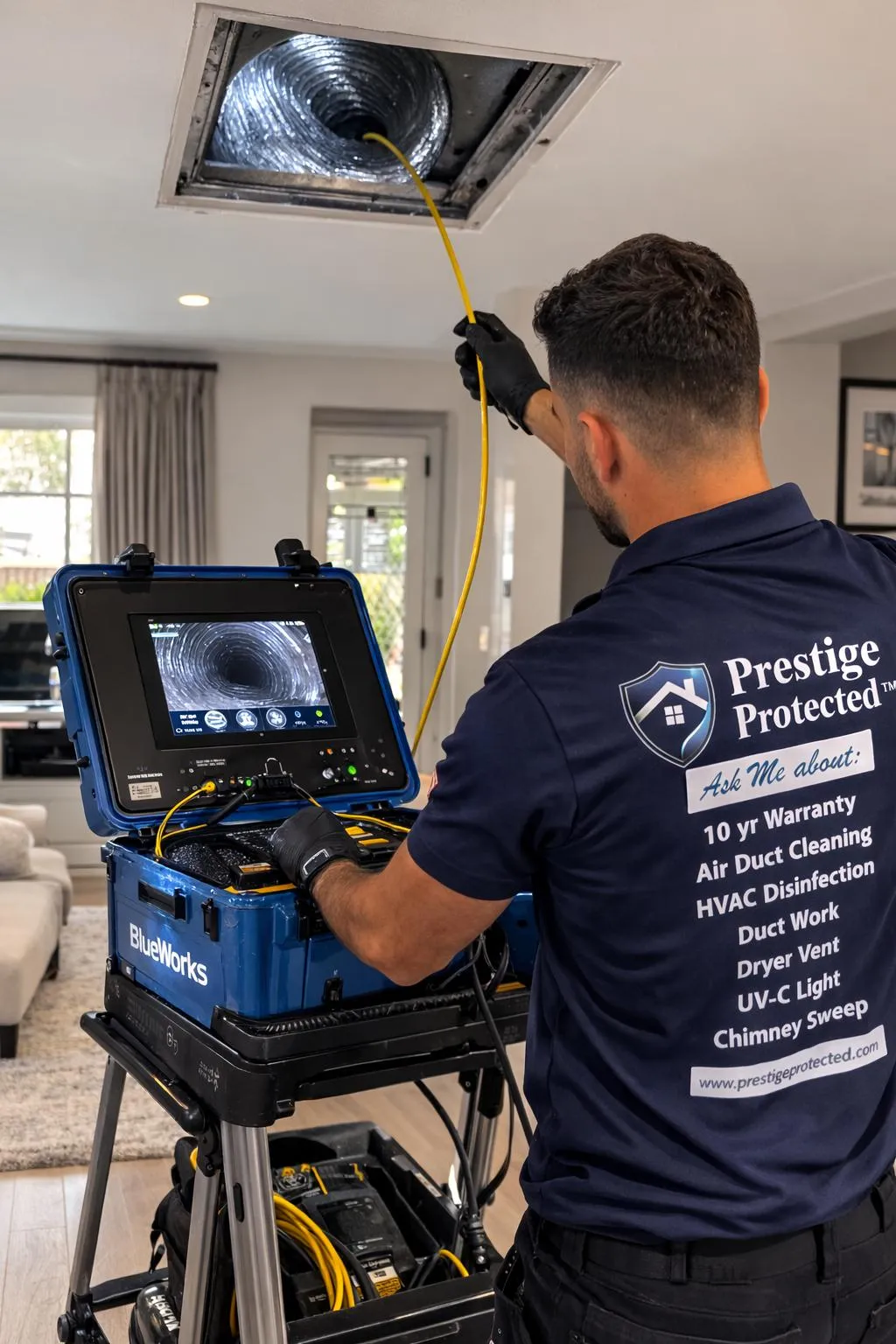
- Shows before-and-after photos and is comfortable with you watching
- Carries insurance and has verifiable local reviews
The questions worth asking
A trustworthy company will answer all of these without hesitation: What does your price include, in writing? Do you clean the whole system or just the registers? What equipment do you use? Will you inspect and show me photos before and after? Are you insured? The EPA specifically recommends asking a prospective provider whether they will clean all components of the system, because a partial cleaning can leave contamination behind that simply recirculates.
What a proper cleaning actually includes
The EPA describes effective duct cleaning as source removal, physically dislodging debris and capturing it under negative air pressure so it leaves the home rather than being blown around. That means the supply and return ducts, the registers and grilles, the main trunk lines, and the air handler components. A crew that only vacuums the register openings is not cleaning your ducts, no matter what the invoice says. If you want to understand pricing before you call, our Cary cost guide and general cost guide lay out what drives the number.
Prestige Protected serves Cary and Raleigh. We inspect first, quote upfront, and are happy to show you what we find at every step.
Frequently asked questions
How much should air duct cleaning cost?
A legitimate whole-home cleaning is well above the “$99” ads you see online, because real source-removal work takes time and equipment. The exact number depends on system size, number of vents and access. Ask for written pricing after an inspection rather than trusting a flat teaser rate.
What questions should I ask an air duct cleaning company?
Ask what the price includes in writing, whether they clean the whole system or just registers, what equipment they use, whether they inspect and show photos before and after, and whether they are insured. Clear answers to all five are a good sign.
Are “$99 whole house” deals legit?
Almost never. They are typically a bait price designed to get a crew in the door, followed by high-pressure upsells. A thorough cleaning cannot be done profitably at that price.
Should the company inspect before quoting?
Yes. A real quote depends on how many vents you have, the system size and the access. Any company quoting a firm price sight-unseen is either guessing or planning to change it once they arrive.
Work with a company that inspects first
The three things a quote should tell you
Most bad duct cleaning experiences are decided at the quote, not on the day of the work. A quote you can hold a company to has three things in it, and a quote designed to grow later is missing at least one.
- A count, not a category. “Whole house” is not a scope. The number of supply openings, the number of returns and the number of air handlers should be written down, because that is what determines the labor. If nobody counted, nobody can be held to the price.
- What is included and what is explicitly not. Registers, plenum, main trunk lines, the dryer run, the exterior termination, the coil: each is either in or out. Vague inclusions are where the on-site add-ons come from.
- Named conditions for a price change. Legitimate reasons exist, such as a second air handler nobody knew about or a roof termination. A good company names them up front. A bad one discovers them once the van is in your driveway.
How to read a company's claims about certification
Duct cleaning is not a licensed trade in North Carolina the way electrical or plumbing work is, which is why marketing in this industry leans so hard on badges. Two useful filters. First, no federal agency certifies duct cleaning companies. If you see a logo implying a government endorsement, that alone is disqualifying. Second, when a company names a trade body, ask which one and what the membership requires, then check the body's own directory rather than the company's website. A real affiliation survives thirty seconds of verification.
The more useful question is not what a company is certified in, but what it will show you. Photographs of the interior of your own ducts, taken before and after, are verifiable in a way that a badge is not.
What the EPA actually says, and why it helps you screen companies
Worth reading before you call anyone: the EPA's guidance on whether you should have your air ducts cleaned. It does not recommend cleaning on a fixed schedule, and it points to specific triggers instead: visible mold growth inside the ducts or on other system components, ducts infested with vermin, or ducts clogged with substantial deposits of dust and debris that are actually being released into the home. It also warns against chemical biocides and sealants applied inside ducts without good reason.
That document is a screening tool. A company that agrees with it, tells you when you do not need the service, and declines to spray something into your system for an extra fee is aligned with the neutral guidance. A company that says every home needs annual cleaning and pushes an antimicrobial add-on is not. The EPA also notes the broader context that makes the service worth doing when it is warranted: indoor air can be two to five times more polluted than outdoor air, and source removal is the most effective response.
A five-minute screening call
You can sort most companies with one phone call. Ask these in order and listen for how quickly the answers get vague:
- “Will someone inspect before I get a price?” A yes that includes photographs is the answer you want.
- “What equipment do you use?” You are listening for HEPA filtration and source removal with mechanical agitation, not “a high-powered blower.”
- “Do you clean the main trunk lines or only the branch runs?” Trunk lines are where the volume of debris sits, and cheap jobs skip them.
- “Who does the work, your employees or a subcontractor?” Either can be fine, but the answer should be immediate.
- “What would make the price change once you are here?” Specific conditions are a good sign. “It depends” is not.
- “Is there anything that would make you tell me I do not need this?” The best answer to this question is the whole point of the call.
For local price context before you compare bids, see air duct cleaning cost in Cary and cost in Raleigh. If a bid is far under both ranges, the write-up on the $99 blow-and-go explains what usually happens next.
More questions before you hire
Is duct cleaning a licensed trade in North Carolina?
No. There is no state license specific to residential duct cleaning, which is why what a company will show you matters more than the badges on its website.
Should I let a company spray a sanitizer or sealant inside my ducts?
Not by default. The EPA advises against applying chemical biocides and sealants inside ductwork without a specific, identified reason. There are narrow cases where a treatment makes sense after cleaning, but it should be explained and optional, never a required add-on.
How many reviews should I expect a legitimate local company to have?
Volume matters less than specificity. Look for reviews that mention the technician by name, the house, the number of vents or a particular problem. A wall of five-star reviews with no detail, all posted in the same short window, tells you less than a dozen detailed ones spread over years.
What should I do before the crew arrives?
Clear access to every register and to the air handler, move breakables away from vents, and if the dryer vent is part of the job, pull the dryer out far enough to reach the hose. Then take your own photo of one or two registers, so you have a baseline that is not the company's.
How do I verify the work was actually done?
Ask for before-and-after photographs of the same locations, including the plenum and at least one trunk line, not just a register cover. Then check airflow at a few registers yourself. If a dryer vent was cleaned, feel the exterior flap during a load.