Quick answer
HVAC disinfection is an antimicrobial treatment applied to duct and coil surfaces after a mechanical cleaning, not instead of one. It is worth doing when an inspection finds actual microbial growth, after water damage, or when a musty smell survives a proper clean. Per EPA guidance we do not apply biocides to ductwork as a routine add-on.
HVAC Services · Disinfection
HVAC disinfection treats the surfaces inside your air handler and ductwork where mold and bacteria have taken hold. It is a targeted follow-up to a cleaning, used when there is a documented reason for it, and we show you that reason on camera before recommending it.
- Applied after cleaning, never instead of it
- Recommended only when the inspection supports it
- Serving the NC Triangle and Boca Raton, FL
Reviewed by the Prestige Protected Team · Updated September 2026
What HVAC disinfection actually is
After the ductwork and coil have been mechanically cleaned, an antimicrobial product is applied to the interior surfaces to kill remaining mold spores and bacteria and slow their return. It is a surface treatment. It does not remove dust, it does not seal leaks, and it cannot work through a layer of debris, which is why any company offering disinfection without cleaning first is selling you something that will not do anything.
The honest version of this service is narrow. The U.S. EPA is explicit that biocides should not be routinely applied inside air ducts, and that few products are registered for that use at all. We treat it the same way: it is a solution to a specific, visible problem, not a line item added to every invoice.
When disinfection is genuinely worth it
- The camera inspection finds visible microbial growth on the coil, plenum or duct interior
- The air handler or ductwork has been through water damage, a flood, or a condensate overflow
- A musty smell persists after a thorough duct and coil cleaning
- A household member has a diagnosed mold allergy or is immunocompromised, and growth has been confirmed
- The system has sat unused and damp for a long period, such as a vacant or seasonal property
In Florida the trigger is usually humidity. A Boca Raton air handler runs against high dew points nearly year-round, and a coil that never fully dries between cycles is the single most common place growth starts. In the Triangle it is more often a one-off event, a flooded pan, a leak, a crawlspace duct that pulled in damp air for a season.
How much of the job is the disinfection itself?
A small part of it. The cleaning is the work; the treatment is a short final step on surfaces that have already been cleaned. If a quote is mostly disinfection with little cleaning behind it, the order of operations is wrong.
Will you tell me if I do not need it?
Yes, and we frequently do. The camera inspection either shows growth or it does not. If it shows dust, you need a cleaning and nothing else, and that is what we will quote.
How long before we can use the room again?
Until the product has dried, and the exact interval depends on the product. We give you that number before we start rather than after, so you can plan around it.
Does it stop the growth coming back?
It slows it. Growth returns if the conditions that caused it are still there, which usually means moisture: a wet coil, a blocked drain, or humid air being pulled into the ducts. Fixing the moisture is what makes the result last.
Is this the same as fogging or ozone treatment?
No. We apply a product to cleaned surfaces where growth has been found. We do not use ozone generators, which the EPA notes can be harmful at concentrations that do not effectively remove contaminants.
Last updated by the Prestige Protected service team.
What the visit actually looks like
Disinfection is the last ten minutes of a longer appointment. Here is the order of work, because the order is the whole point.
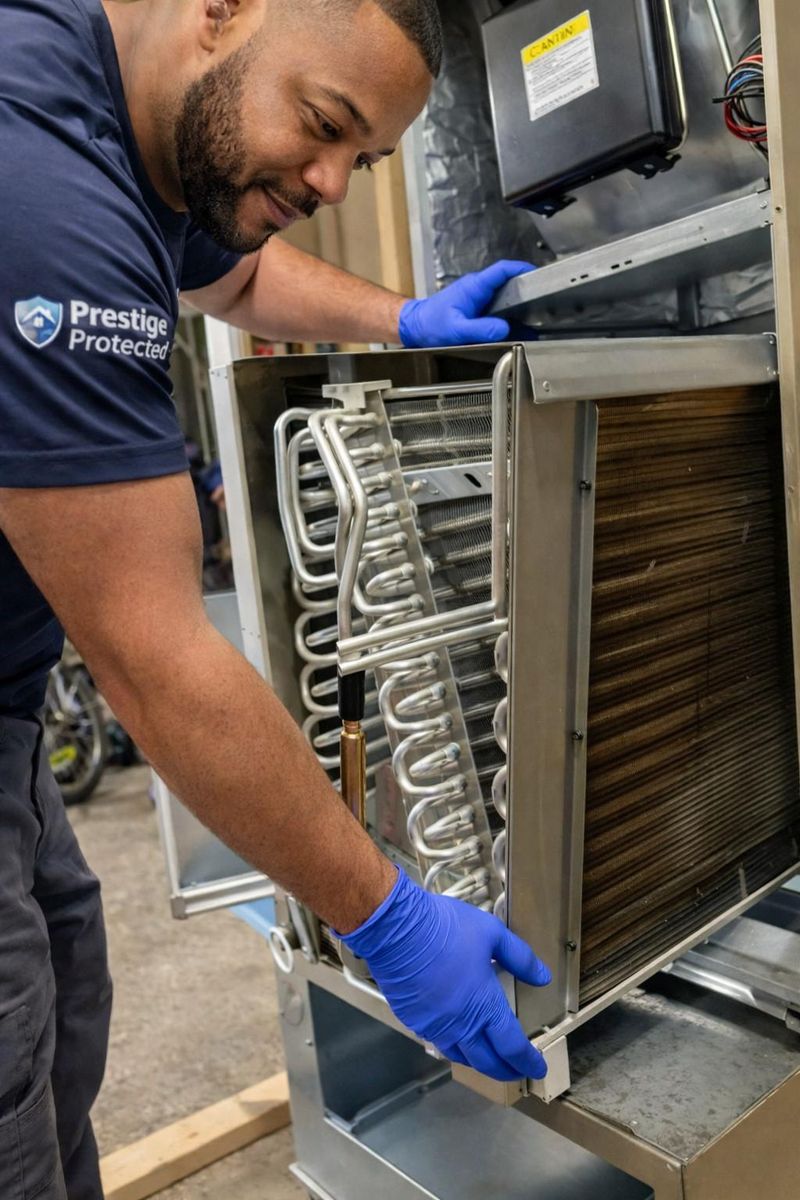
- We open the system and inspect it on camera. You see the coil, the plenum and the duct interior as they are, before anything has been touched.
- If there is growth, you see it on the screen and we tell you where it is and how far it extends. If there is only dust, we say so, and disinfection comes off the quote.
- The ductwork and coil are cleaned mechanically, with brushes and vacuum collection. Nothing is applied to a dirty surface.
- The antimicrobial is then applied to the cleaned surfaces where growth was found, and only those.
- The area stays unoccupied until the product has dried. We tell you the re-entry time for the specific product before we start.
- You get before and after photographs of the same spots, so you can look at the result instead of taking it on trust.
What disinfection does not fix
Most musty-smell calls turn out to have a mechanical cause, and an antimicrobial does nothing for any of them:
- A blocked condensate drain. Standing water in the pan smells, and the smell keeps coming back until the drain runs freely.
- A coil that never dries. An oversized system short-cycles, so the coil stays wet. That is a sizing and run-time problem.
- Unsealed duct joints. Leaky returns in a damp crawlspace pull humid air straight into the system. Sealing is HVAC work. We do not do it and we do not sell it.
- A saturated filter. A filter left in past its life holds moisture and dust against the airflow.
- Dust, dander and construction debris. That is a cleaning job. Disinfection removes nothing physical at all.
This is why we inspect before quoting. Selling a treatment for a problem it cannot solve is the most common way this service gets misused in our industry.
For scale on why any of this matters: the U.S. EPA reports that Americans spend approximately 90 percent of their time indoors, where concentrations of some pollutants are often two to five times higher than typical outdoor concentrations. That is the reason to get the mechanical cleaning right. It is not a reason to add an antimicrobial to every job.
What the EPA says, and why we follow it
EPA does not recommend that sealants be used except as a last resort… Before you allow a service provider to use a chemical biocide inside your ducts, be sure the service provider has applied it correctly, and that the product is registered for use inside ducts.
U.S. EPA, Should You Have the Air Ducts in Your Home Cleaned?
The practical version: very few products are registered for application inside ductwork, and routine use is not supported. So we do not bundle it, we do not add it to every invoice, and we say no to it more often than we say yes.
Where we do this work
Sanitizing is a follow-up to cleaning across our whole service area. In North Carolina that is Cary, Raleigh and the surrounding Triangle, and you can see the full list on our service areas page. In Florida it is Boca Raton, where near year-round humidity means a coil that rarely dries and a much higher hit rate on confirmed growth. If you want the problem measured rather than described, air quality testing before and after is the way to do that, and mold in air ducts explains how we tell growth from ordinary dust.
How this differs from mold remediation
The two get confused, so it is worth separating them. Disinfection treats surfaces inside the duct and the air handler after those surfaces have been cleaned. Mold remediation is a bigger job: it deals with growth on building materials, addresses the water source that fed it, and may involve containment and removal of material that cannot be cleaned. If growth has spread past the ductwork onto framing, drywall or insulation, disinfecting the ducts treats a symptom and leaves the cause. Mold removal in Raleigh and mold removal in Cary cover that work, and the inspection tells us which of the two conversations we are actually having.
What happens if the inspection finds nothing
Then we say so and the line comes off the quote. This happens often enough that it is worth stating plainly: a system can look neglected from the outside, with dusty registers and a filter well past its life, and still have nothing growing inside it. Dust is not growth. In that case you need a cleaning and a filter, and an antimicrobial would be money spent on a problem you do not have. You still get the camera footage and the photographs, so you can see for yourself what the decision was based on. If a smell was the reason you called and the inspection comes back clean, the next things to check are the condensate drain and the run time on the system, both of which are mechanical faults rather than growth.
HVAC disinfection in NC and South Florida
FAQ
HVAC disinfection: FAQ
Is HVAC disinfection the same as duct cleaning?
No. Cleaning physically removes the debris; disinfection is an antimicrobial treatment applied afterwards to surfaces where growth has been found. Disinfecting dirty ductwork does not work, because the product cannot reach the surface through the debris. Cleaning always comes first.
Do I actually need it?
Often not. The EPA does not recommend routinely applying biocides inside ductwork, and we follow that. Disinfection makes sense when the camera inspection finds visible microbial growth, after water damage or a flooded air handler, or when a musty smell persists after a thorough cleaning. If we do not see a reason for it, we will tell you.
Will it get rid of a musty smell?
Only if microbial growth is actually the cause. A musty smell at start-up is just as often a wet evaporator coil, a clogged condensate drain, or unsealed duct joints pulling in humid air. The inspection tells us which of those it is, and only one of them is solved by disinfection.
Is it safe for children and pets?
Occupants stay out of the treated area while the product is applied and until it has dried. We will tell you the exact re-entry time for the product used on your job before we start.
Source: U.S. EPA, Should You Have the Air Ducts in Your Home Cleaned?
Related services
- Air duct cleaning, the mechanical cleaning that has to happen first
- AC coil cleaning, the coil is where growth usually starts
- Air quality testing, if you want the problem measured before and after
- Air duct & dryer vent cleaning in Boca Raton, FL