
Quick answer
For most homes, cleaning is enough. Full duct replacement is the exception. Cleaning restores a structurally sound system that has simply gotten dirty; replacement is only warranted when ducts are crushed, collapsed, badly undersized, or contaminated beyond what cleaning can fix. Prestige Protected cleans and inspects ducts (we do not sell replacement), so our recommendation stays honest. Call (888) 404-8321.
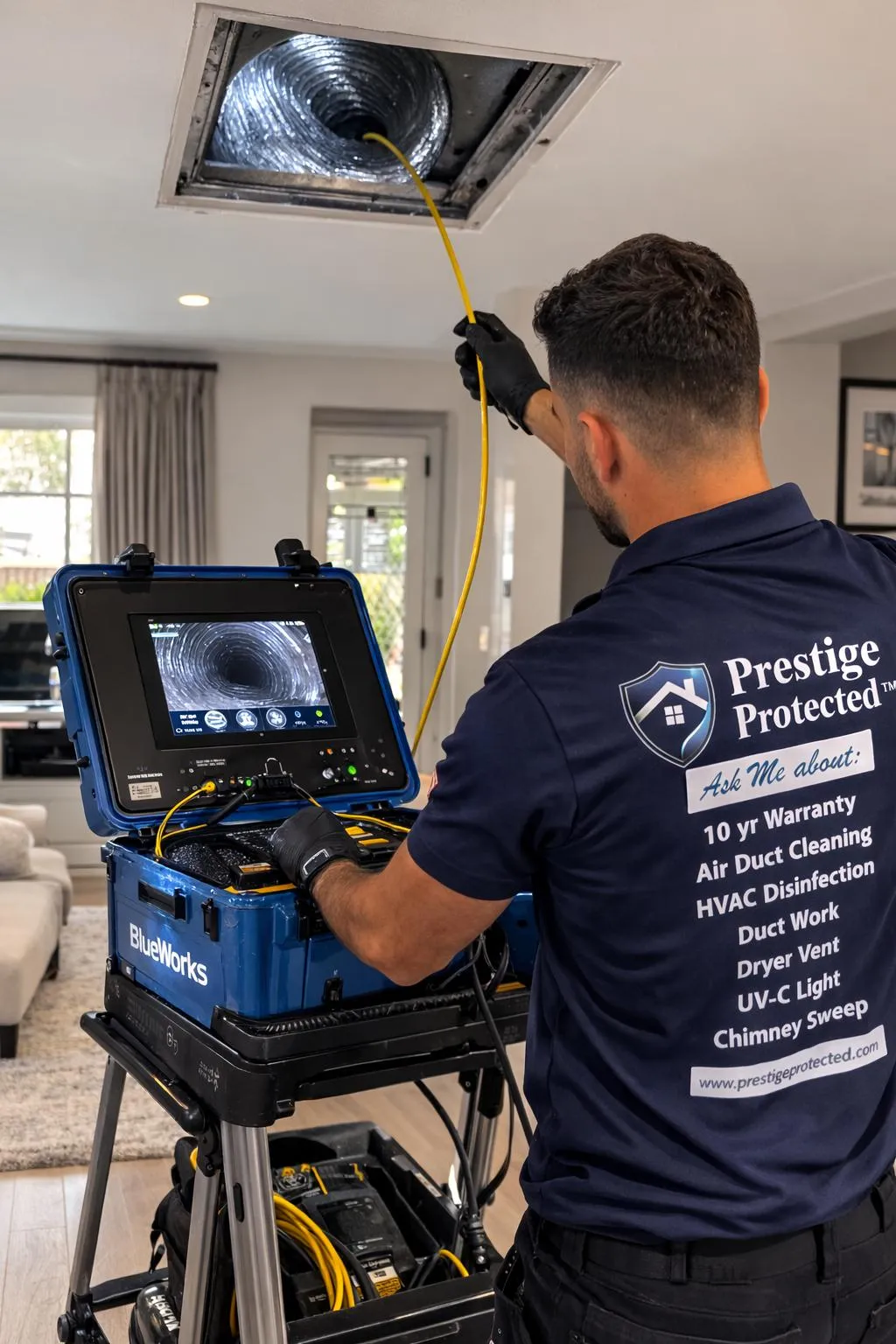
For most homes, cleaning is the answer, replacement is the exception. Duct cleaning restores a structurally sound system that has simply gotten dirty. Replacement is only warranted when the ducts themselves are damaged, collapsed, badly sized, or contaminated beyond what cleaning can fix.
Signs cleaning is all you need
- Dust or debris blowing from vents
- Musty odors or recent renovation dust
- Allergy symptoms indoors
- Ducts are intact but haven’t been cleaned in years
Signs replacement may be warranted
- Crushed, disconnected or collapsed duct sections
- Persistent mold that returns after cleaning and sanitizing
- Ducts badly undersized for the system (poor airflow everywhere)
- Old flex duct that is torn or deteriorating
Our honest approach
Prestige Protected provides professional air duct cleaning, sanitizing and inspection. We do not sell duct replacement, so we have no incentive to push it. If our inspection shows your ducts are damaged beyond cleaning, we will tell you plainly and you can bring in an HVAC contractor for that work. For a deeper, location-specific walkthrough, see our “do you need to replace your ductwork?” guide.
Replacement is the answer far less often than the internet suggests. In most Triangle homes the ductwork is intact and dirty, which is a cleaning job. The cases where it genuinely needs replacing share a short list of conditions, and all of them are visible on a camera.
Six duct conditions that cleaning cannot fix
This is the list we work from on a visit. If we find one of these, we say so, we photograph it, and we tell you that the next call is to a licensed HVAC contractor rather than to us.
- Wet or moldy insulation. This is the clearest case, and it is not our opinion. The U.S. Environmental Protection Agency states that if the ducts have insulation inside them and that insulation gets wet or moldy, it cannot be effectively cleaned and should be removed and replaced. Fiberglass liner holds water and holds growth, and no amount of brushing changes that.
- A torn or shredded flexible liner. Once the inner liner is open, the duct is drawing from the attic or crawlspace rather than from your rooms. Cleaning a run in that condition mostly moves insulation fibers around.
- A crushed or kinked run. Flexible duct that has been stood on, pinched behind a joist or squeezed by stored boxes has lost its cross-section permanently. It will be just as restricted after cleaning as before.
- A permanent sag or belly holding water. A run that dips between supports collects condensate at the low point. That is a moisture source that regenerates every cooling season, and straightening or replacing the run is the only fix.
- Fire, smoke or sewage contamination. Duct interiors that have taken smoke or sewage are a remediation and replacement question, not a cleaning question.
- Duct so undersized or badly routed that rooms have never been comfortable. If the system has never worked properly since the house was built, the problem is design. Cleaning a badly designed system returns it to being a badly designed system.
How the decision usually goes in a Triangle home
There are two dominant building patterns around Cary and Raleigh and they fail in different ways, which makes the call fairly predictable before we even open a register.
In the attic-air-handler house, typically late 1990s through the mid 2000s, the runs are flexible duct laid across joists above insulation. What we find here is heat damage to the outer jacket, tape that has released at the takeoffs, and runs that have been walked on by whoever last serviced the system or ran a cable. The liners themselves are often fine. These houses are usually a cleaning job plus a written note about two or three connections for an HVAC contractor to re-fasten.
In the crawlspace house, the runs are under the floor in the most humid space on the property. This is where we find the sags, the standing condensate and the wet liner, and it is the pattern that produces genuine replacement recommendations. It is also the pattern where a smell complaint is most likely to be real rather than imagined. Our mold in air ducts guide explains what is cleanable and what is not.
Sheet metal trunk lines, which most older homes here still have somewhere, are the durable exception. Rigid galvanized duct routinely outlives two air handlers. When someone quotes you a whole-system replacement and your trunk is sound sheet metal, ask specifically which sections are being replaced and why.
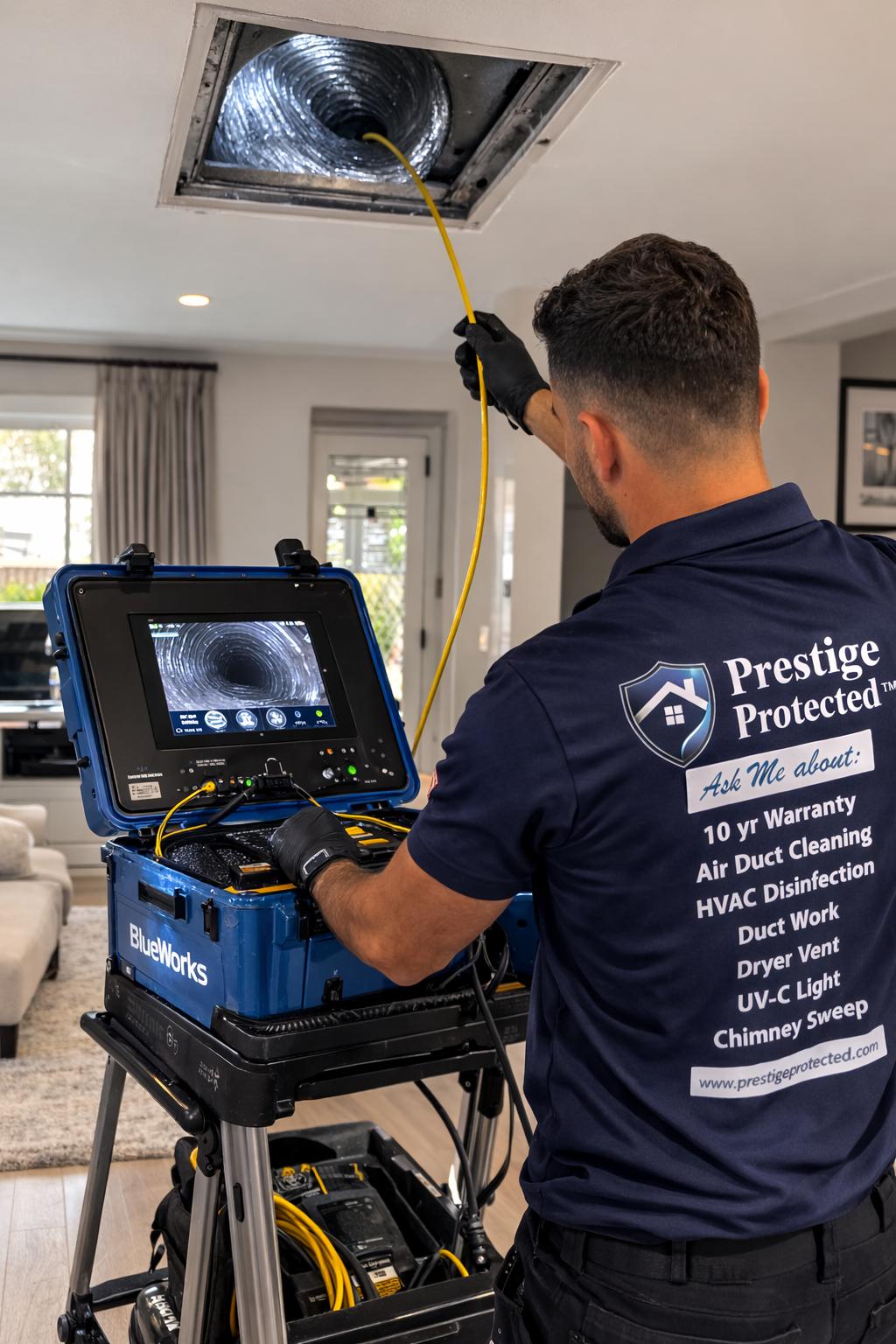
What the EPA actually says about when to clean
Homeowners deserve the source rather than a paraphrase. The EPA identifies three situations in which duct cleaning is warranted: substantial visible mold growth inside the hard surface ducts or on other components of the heating and cooling system, ducts infested with vermin such as rodents or insects, and ducts so clogged with dust and debris that particles are actually released into the home from the supply registers.
The same document notes that duct cleaning “has never been shown to actually prevent health problems,” and that studies do not conclusively demonstrate that particle levels in homes rise because of dirty air ducts. We quote this on purpose. A company that hides it is hoping you never find it, and a diagnosis is worth more to you than a pitch.
The practical use of the list is as a filter on your own spending. If a camera shows none of the three, and the ductwork is intact, then neither cleaning nor replacement is urgent, and the best money in the house is a filter that fits its frame and a yearly professional check-up.
What a replacement quote should contain
We do not sell duct replacement, so treat this as a checklist to take to the contractors who do. A quote that answers all six of these is from someone doing engineering. A quote that answers none is a number.
- Which sections, by name and location. Trunk, plenum, specific branch runs, boots. Not “ductwork.”
- Material and R-value. Flexible duct comes in different insulation values, and runs in an unconditioned attic or crawlspace need the higher one. The Department of Energy recommends insulating ducts in unconditioned spaces for exactly this reason.
- Whether the design is being recalculated. If rooms have never been comfortable, replacing the same duct in the same sizes reproduces the same problem. Ask whether a load and duct sizing calculation is part of the job.
- How joints will be sealed and supported. Mastic or UL 181 foil tape, and strapping at the intervals the manufacturer specifies rather than wherever the run happens to rest.
- Permits and inspection, if your work requires them. Ask, and get the answer in writing.
- Photographs before and after. All of this happens in a space you will never crawl into. If nobody photographs it, you are buying a story.
When replacing one section is the right answer
Partial replacement is common, sensible and under-quoted. A single crushed branch, one torn run, or a boot that has come away from the drywall are all local repairs, and there is no technical reason to replace a whole system because one run failed. The exceptions are the ones where the cause is systemic rather than local: wet liner in several runs at once means the crawlspace is the problem, and replacing one run leaves the others to fail the same way.
The sequencing question comes up next, and the answer is usually straightforward. If you are replacing the air handler this year, do the duct work at the same time, because the system will be open anyway and the connections have to be remade regardless. If the air handler has years left, a section repair now is not wasted money.
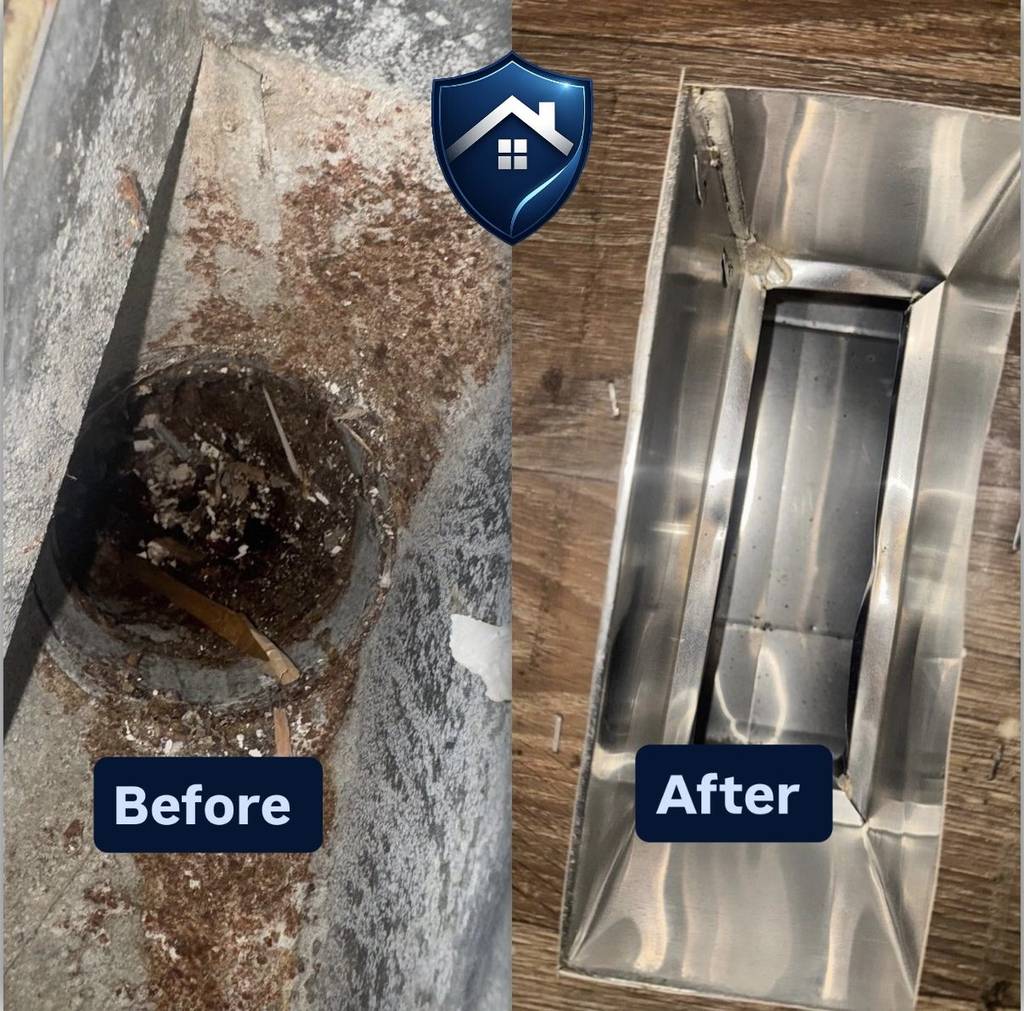
What we will not do
We do not replace ductwork, we do not seal ducts, we do not quote either one and we do not take a referral fee from anyone who does. Our services are air duct and dryer vent cleaning, dryer vent repair and replacement, inspection, sanitizing, coil cleaning, indoor air quality testing, preventative maintenance and mold remediation. That boundary is the reason our answer to the cleaning-or-replacement question is worth something: we do not profit from the more expensive one, and we lose nothing by telling you your ducts are fine.
Last updated by the Prestige Protected service team.
For the Cary-specific version of this decision, including local build eras and how to read a quote, see air duct replacement in Cary, NC.
Frequently asked questions
Is cleaning a waste of money if I might replace later?
Usually not. Cleaning is far cheaper and solves the problem in the large majority of homes. Replacement is only cost-effective when ducts are genuinely damaged.
Can you tell me which I need?
Yes. Our inspection documents the condition of your ducts with photos so you can make an informed decision, clean, or bring in a contractor for repair/replacement.
How long ductwork usually lasts
Well-installed sheet-metal ducts can last the life of a home. Flexible ducting has a shorter service life and is more prone to tears, crushing and sagging over roughly 10 to 15 years. Age by itself is not a reason to replace, condition is. That is why we document what we actually find instead of recommending replacement based on the year the house was built. If your ducts are sound, cleaning is far cheaper and solves the problem in the large majority of Triangle homes.
What replacement typically involves
When ducts genuinely need replacing, it is HVAC contractor work: removing the damaged runs, sizing and installing new sheet-metal or insulated flex duct, and sealing the connections. It is more disruptive and more expensive than a cleaning, which is exactly why it should only follow clear evidence of damage. Because Prestige Protected does not sell replacement, we have no reason to steer you toward it, we clean, sanitize and inspect, then hand you documented photos so any contractor you do call is working from the same facts you are.
What we look for on camera
Crushed or kinked flex duct, joints that have separated, interior liner damage, moisture staining and rust, evidence of pests, and the difference between ordinary dust and suspected mold growth, which the EPA treats as a specific trigger for action. Each of these points to a different fix. Dust means cleaning. A single crushed run means a spot repair. Widespread liner failure or moisture damage is when replacement enters the conversation. Our system inspection covers this, and if mold is the concern, see our mold remediation service for Cary.
Does duct cleaning damage older ductwork?
Not when the system is assessed first. Older or fragile sections get gentler agitation and rely more on HEPA-filtered negative pressure to pull debris out. If a section looks too fragile to clean safely, we flag it and show you rather than forcing the issue; that section was already a repair waiting to happen.
Can one damaged section be replaced instead of the whole system?
Often, yes. A single crushed flex run or a separated boot connection is a targeted fix a licensed HVAC contractor can make without touching the rest of the system. This is exactly why an inspection pays for itself: it pinpoints which runs have a problem so you only replace what is actually failing.
How long does flexible ductwork usually last?
In our field experience across Triangle homes, flexible duct in a conditioned or mildly loaded space commonly gives fifteen years or more, while the same product baking in an attic or sagging in a humid crawlspace can be visibly failing in ten. Rigid galvanized sheet metal trunk lines routinely outlast two air handlers. Rather than trusting an age, look at the condition: an intact liner, a round cross-section and dry insulation matter more than the date on the label.
Can mold be cleaned out of ductwork, or does it have to be replaced?
It depends on the surface, and the EPA draws the line clearly. On hard surfaces such as sheet metal, growth can be cleaned. Where the duct has insulation inside it and that insulation has got wet or moldy, the agency states it cannot be effectively cleaned and should be removed and replaced. That is why our first question on a mold call is what the duct is made of, and why we photograph the liner before quoting anything. Our mold remediation page covers the work itself.
Will cleaning damage older ductwork?
Done properly, no, and this is a fair question and the answer on a failing system is yes. The risk is real on a system that is already failing: brushing a shredded liner or a joint held together by dried-out tape can finish what time started. That is exactly why we inspect before we clean, and why we will decline a job we cannot do safely. If a run is torn or crushed, we stop, photograph it and tell you it needs repair, because cleaning it would be billing you for something that cannot work.
Do you replace ductwork?
No. We clean air ducts and dryer vents, repair and replace dryer vents, inspect, sanitize, clean coils, test indoor air quality and remediate mold. Duct replacement is work for a licensed HVAC contractor. When we find ductwork that needs replacing we hand you the photographs and a written summary and you take it to whoever you choose, with no referral arrangement on our side.
Should I replace my ducts when I replace the HVAC system?
If the duct work needs doing at all, doing it during a system change is the efficient time, because the connections are being remade anyway and the equipment is already out. It is also the moment to ask whether the duct sizing still suits the new equipment, since a modern variable-speed system moves air differently from a twenty-year-old single-stage unit. If your ducts are sound, a system swap is not a reason to replace them, and you should push back on a quote that assumes otherwise.
What if there might be asbestos in the old duct insulation?
Stop, and do not let anyone brush, cut or vacuum it. Some older duct insulation and pipe wrap contains asbestos, and disturbing it is the hazard. If a material is suspect, it needs testing and, if positive, a licensed abatement contractor. We will not clean or work on suspected asbestos-containing material, and we will tell you on the spot rather than after the fact.
Not sure whether your ducts can be cleaned?
We’ll inspect, show you photos, and give you a straight answer.
For a Raleigh-specific walkthrough of the same decision, see do you need to replace your ductwork in Raleigh.