
Quick answer
If your dryer vent traps lint no matter how often it is cleaned, the route itself is usually the problem: too long, too many bends, or a bad exit point. Rerouting replaces the run with the shortest, straightest metal path to the outside, within code limits, so the line stops clogging in the first place. It is a half-day job for most Raleigh and Triangle homes, quoted in writing after we scope the existing run.
Sometimes the problem isn’t a dirty vent, it’s a bad route. A dryer vent that runs too far, turns too many times, or exits in a hard spot will trap lint no matter how often it’s cleaned. In those cases, re-running the duct a shorter, straighter path as part of a full line replacement is the lasting fix. Prestige Protected serves the NC Triangle, call (888) 404-8321.
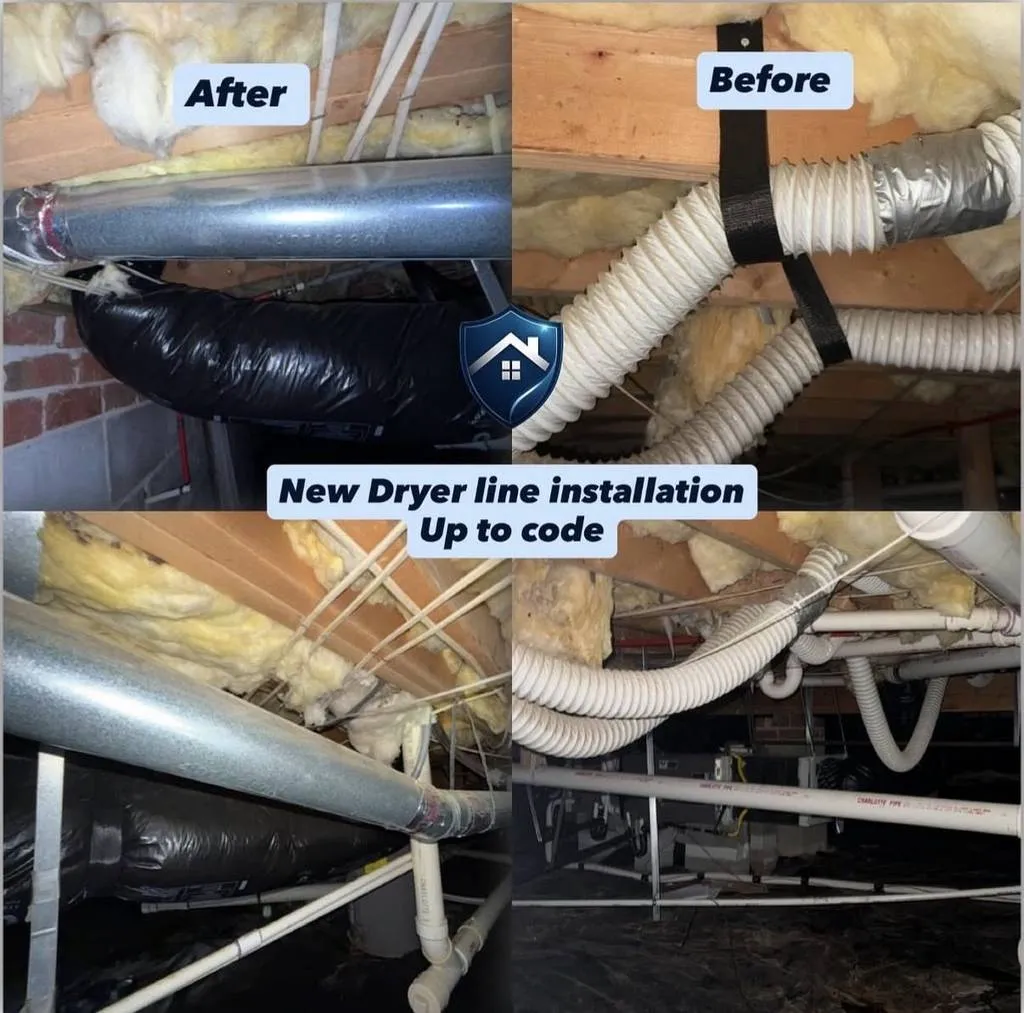
When a dryer vent should be re-run
- The run is longer than code allows (IRC M1502 caps a 4″ vent at 35 ft, minus 2.5–5 ft per bend)
- Multiple sharp 90° bends choke airflow
- Clothes still take too long to dry after a cleaning
- The vent terminates somewhere lint and pests easily get back in
How we handle it
We assess the existing route, then replace and re-run the line with rigid metal duct on the shortest safe path to the exterior, finishing with a proper exterior hood. It’s done as part of a full line replacement, not a patch.
Related: disconnected attic vents, transition hose replacement, and repair & replacement cost.
For the cleaning itself, see Cary or Raleigh.
Frequently asked questions
Can you re-run a dryer vent a shorter way?
Yes, as part of a full line replacement we re-run the duct the shortest safe path to the exterior with rigid metal. Call (888) 404-8321.
How long can a dryer vent be?
The IRC (M1502) generally caps a 4-inch vent at 35 feet, reduced by 2.5–5 feet for each bend. Long or winding runs are good candidates for re-running.
Dryer vent run too long or winding?
Call (888) 404-8321 about re-running it as part of a replacement.
How do I know whether I need a reroute or just a cleaning?
Measure the run and count the corners, then compare it to the 35 foot budget with 5 feet deducted per square bend. If you are inside that number and the line has simply never been cleaned, clean it. If you are well past it, or if a run that was cleaned within the last year is already slow again, the route is the problem and cleaning is a subscription rather than a fix.
Does rerouting mean cutting into my walls or ceiling?
Usually far less than people expect, because the whole point of a reroute is to find the shortest honest path rather than to chase the old one. Most of ours involve one new exterior penetration and work in an attic or crawlspace. Where drywall has to be opened we tell you exactly where before we start, and we do not patch and paint, so you know what is left to arrange.
Can the dryer vent exit through the roof?
It can, and sometimes there is no alternative in a condo or an interior laundry room. It is our second choice rather than our first, because a vertical run collects lint at the base, roof caps are harder to inspect, and getting up there for maintenance is a bigger job. If a roof termination is the right answer we use a cap designed for a dryer rather than a repurposed wall vent, and we tell you the maintenance trade-off up front.
How long does a reroute take, and do I need to be home?
Most take half a day. Someone should be home at the start so we can agree the new route and where the exterior penetration goes, and at the end so you can see the photos and watch a load run through it. In between you can get on with your day.
Will a booster fan solve a long run instead?
Sometimes, and we are careful about it. Inline boosters exist for exactly this problem, but they add a powered device to the line, they need their own maintenance, and a badly chosen one collects lint and becomes the blockage. Where a shorter route is physically possible, we would rather build the shorter route. Where it genuinely is not, that is a conversation to have with the equipment specifications in front of us rather than a promise on a web page.
Is a reroute worth it if we plan to sell in a year?
Often yes, for a reason that has nothing to do with resale value. Long drying times and a vent that discharges into the attic are both things a home inspector writes up, and a write-up during a sale gets negotiated at the buyer’s number rather than yours. Fixing it beforehand with photos on file is the cheaper version of the same conversation.
Reroute or just clean? How to tell
A cleaning fixes a dirty vent; a reroute fixes a badly designed one. The tell is the interval: a well-routed vent in a typical home needs cleaning about once a year, per the guidance behind the U.S. Fire Administration’s dryer-fire numbers. If yours clogs in three or four months, the route is fighting you. Every bend and every extra foot slows the air, and slow air drops its lint. Code (IRC M1502) caps a standard 4-inch vent at 35 feet, with each bend counting 2.5 to 5 feet against the total, plenty of Triangle homes with upstairs laundry rooms are at or past that limit as built.
How a reroute works
- Scope the existing run. We map where the duct actually goes, owners are regularly surprised, and measure the effective length with bends counted.
- Plan the shortest legal path. Usually that means a more direct route through the attic, crawlspace or wall to a closer exterior exit.
- Run rigid metal duct, properly supported so it cannot sag, joints clamped and foil-taped, no screws into the airstream.
- Fit a proper exterior hood with a working damper, pest-resistant without a lint-catching screen cage.
- Verify and photograph. Strong airflow at the hood, photos of the finished run, and a written record of what was installed.
One honesty note: rerouting is duct work on the dryer line, which we install and repair. We do not do HVAC ductwork replacement, if your question is about the heating-and-cooling ducts, that comparison is covered in our cleaning vs replacement guide. For the dryer side, see Raleigh dryer vent repair, transition hose replacement, and how often a vent needs cleaning. We serve Raleigh, Cary and the wider Triangle.
Some vent runs cannot be fixed by cleaning them. If the route itself is too long, too twisted or terminating in the wrong place, cleaning buys you a few good months and then you are back where you started. The question is how to tell, and there is an actual number for it.
How long is too long? The number the code uses
The model residential code is specific about this, which is useful because it turns an argument into arithmetic. Under the exhaust systems chapter of the International Residential Code, the maximum developed length of a clothes dryer exhaust duct is 35 feet from the dryer location to the wall or roof termination. Bends count against that budget: the allowance is reduced by 2 feet 6 inches for each 45 degree bend and 5 feet for each 90 degree bend.
Work an example. A first-floor laundry in a Raleigh two-story that runs 26 feet of pipe up into the attic and across to a gable wall, with four 90 degree elbows along the way, has an effective length of 26 plus 20, which is 46 feet. That run is over the limit before you account for a partially blocked cap. No amount of cleaning changes the arithmetic, and the dryer will keep tripping its thermal cut-out on heavy loads.
Two caveats so we are being accurate rather than dramatic. First, some manufacturers publish their own maximum lengths, and the appliance instructions can be stricter than the code. Second, a longer run is legal in some cases where the manufacturer permits it or a listed booster is engineered in. What matters for you is the practical version: if your effective length is well past 35 feet, cleaning is maintenance on a design problem.
Measure your own run in ten minutes
- Find where the line leaves the dryer and note whether it goes down into a crawlspace, up into a ceiling, or straight back through the wall.
- Find the outside termination. Walk the exterior with the dryer running and look for the cap with warm air coming out. If you cannot find it, that is itself a finding.
- Pace the horizontal distance between those two points, one stride to a yard, and multiply by three for feet. Rough is fine.
- Add the vertical. Roughly ten feet per story, plus whatever the run climbs inside the attic.
- Count the corners. Every direction change you can see or reasonably infer. Add five feet for each square corner and two and a half for each gentle one.
- Compare the total to 35. Over it, or close to it with a load of towels taking ninety minutes, and rerouting is worth pricing rather than dismissing.
While you are out there, look at the cap itself. A flap that does not swing freely, a screen behind the louvers, or a bird guard packed with felted lint will strangle even a short, well-built run.
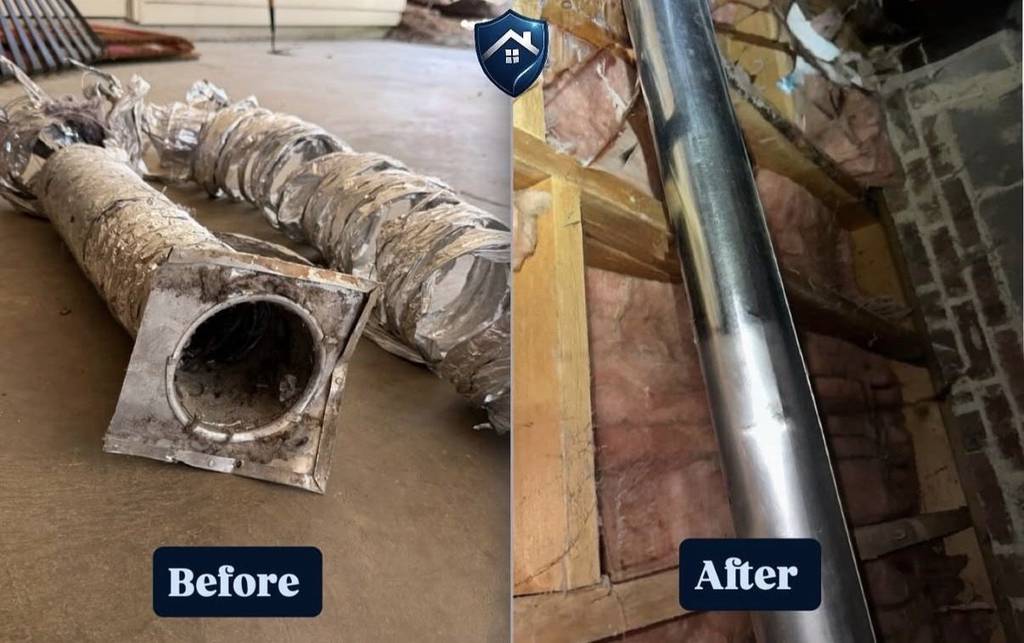
What a reroute usually looks like in a Triangle house
- Find the nearest exterior wall and go there. The most common reroute we do is abandoning a long attic journey in favor of a short, straight path through the closest outside wall, often at the band board. Twelve feet with one bend beats forty feet with four every time.
- Drop instead of climb, where there is a crawlspace. A short run down through the floor and out the foundation wall is frequently the cleanest option in older Raleigh homes, and it puts the whole run where it can be inspected later.
- Rigid metal pipe, mechanically fastened, sloped and supported. Smooth-wall rigid duct with the joints running in the direction of airflow so lint is not caught at every seam. No screws protruding into the airstream, which is a classic cause of a lint dam.
- A termination that suits the location. A proper wall cap with a free-swinging damper and no interior screen, positioned clear of walkways, soffit vents and windows. Roof terminations are sometimes unavoidable and need a cap built for that job rather than a repurposed wall vent.
- Documented, then tested. Photos of the new run before it is closed up, then a real load run through it while we watch the airflow at the cap.
If the existing route is basically sound and the problem is a crushed or disconnected section, that is a repair rather than a reroute. Our repair page explains where that line sits, and the disconnected attic vent page covers the single most common version of it.
What rerouting will not fix
- A failing dryer. A bad heating element, a worn belt or a failed thermal fuse produces long drying times that no duct work will improve.
- A lint screen nobody cleans. Unglamorous, and still the first thing to rule out.
- A foil or plastic transition hose. That short flexible piece behind the machine is its own problem with its own rules, covered on our transition hose page.
- An overloaded machine. Anything past about three quarters full dries slowly no matter how good the venting is.
- A shared or association-controlled stack. In a condo or townhome, part of the run may not be yours to change. We will document where the boundary is so you can take it to the management company.
Why this is a safety job, not just a convenience one
The U.S. Fire Administration reports roughly 2,900 clothes dryer fires in residential buildings each year and states the cause directly: “Failure to clean (31%) was the leading factor contributing to the ignition of clothes dryer fires in homes from 2018-2020.” A run that is too long to keep clean is, in practice, a run that will not stay clean, whatever your intentions are. That is the honest argument for fixing the route rather than scheduling more cleanings.
There is a moisture argument too. Every load pushes roughly a gallon of water as vapor through that line. When a long run leaks or discharges into an attic or crawlspace instead of outside, that water goes into the structure. The EPA notes water-damaged areas and items should be dried within 24 to 48 hours to prevent mold growth, and a dryer vent is a reliable way to deliver warm moisture to a dark cavity several times a week.
Last updated by the Prestige Protected service team.
More rerouting questions
How do I know if my dryer vent run is too long?
Add up the straight footage and subtract 2.5 to 5 feet for every bend; past about 35 feet of effective length, a standard vent is beyond what code assumes. Practically: if clothes need two cycles, the top of the dryer runs hot, and the vent clogs within months of a cleaning, the run is telling you it is too long.
Where should a dryer vent exit?
Through an exterior wall or the roof, with a damper that closes when the dryer is off. Never into an attic, crawlspace, garage or soffit intake, and soffit exits directly under attic vents can pull moist lint-laden air right back into the attic.
How long does a reroute take?
Most are done in half a day, including cleaning up and verifying airflow. Complicated paths, second-floor laundry with no attic access, brick exteriors needing a new penetration, can run longer, which shows up in the written quote, not as a surprise.
Is rerouting worth it versus just cleaning more often?
If the route is genuinely bad, yes: cleaning a 45-foot, five-bend line every three months costs more within a couple of years than fixing the run once, and between cleanings you are still running a lint-loaded vent, which is the fire risk the U.S. Fire Administration’s 2,900-fires-a-year figure keeps pointing back to.