
Quick answer
If you can see mold inside ducts or on HVAC components, or a musty smell hits every time the system runs, the EPA advises having the system professionally cleaned and, critically, fixing the moisture source so the mold does not return. In the Triangle’s humid climate the usual culprits are a damp evaporator coil, condensation on uninsulated duct runs, and summer indoor humidity above 60%.
Air Quality · Mold
If there’s visible mold inside your air ducts or on HVAC components, the EPA recommends having the system professionally cleaned, and the moisture source fixed so it doesn’t return. Mold in ducts can spread spores and a musty smell through your home every time the system runs. In NC’s humid climate it’s one of the most common reasons homeowners need duct cleaning. Here’s what to do.
By the Prestige Protected Team · Cary, Raleigh & the NC Triangle
Signs of mold in your air ducts
- A persistent musty or mildew smell when the HVAC runs
- Visible black, green, or white growth around vents/registers
- Worsening allergy or respiratory symptoms indoors
- Recent water damage, leaks, or high indoor humidity
What to do about duct mold
Per the EPA, cleaning is appropriate when there’s substantial visible mold, but it must be paired with fixing the underlying moisture problem, or the mold returns. Our process removes the contamination at the source and applies an EPA-registered treatment, then we advise on humidity control. Related: air duct cleaning & allergies and musty smell from vents.
Source: U.S. EPA guidance on air duct cleaning and mold.
Last updated by the Prestige Protected service team.
The number that decides whether duct mold comes back
Mold needs a food source, a surface and water. In a duct system the food and the surface are always available, which means water is the only variable you can control, and in the Triangle that means indoor humidity.
The EPA advises keeping indoor relative humidity below 60 percent, ideally between 30 and 50 percent, because above roughly 60 percent condensation forms on cool surfaces and growth becomes likely. It also points out that relative humidity can be measured with an inexpensive moisture or humidity meter from a hardware store. That meter is the single most useful thing a homeowner can buy after a duct mold problem, because it turns a guess into a reading.
Keep indoor humidity below 60 percent relative humidity (ideally between 30 and 50 percent) relative humidity.
U.S. Environmental Protection Agency, A Brief Guide to Mold, Moisture and Your Home EPA
Read it on a humid afternoon in July, not on a dry morning in October. If the hallway reads over 60 percent, no amount of duct cleaning will hold. If it reads in the forties, cleaning has a chance of being permanent.
Four places the water is actually coming from
In eight years of Triangle jobs, duct mold traces back to one of four sources far more often than to anything else. Each one has a different fix and a different cost, which is why finding the source first saves money.
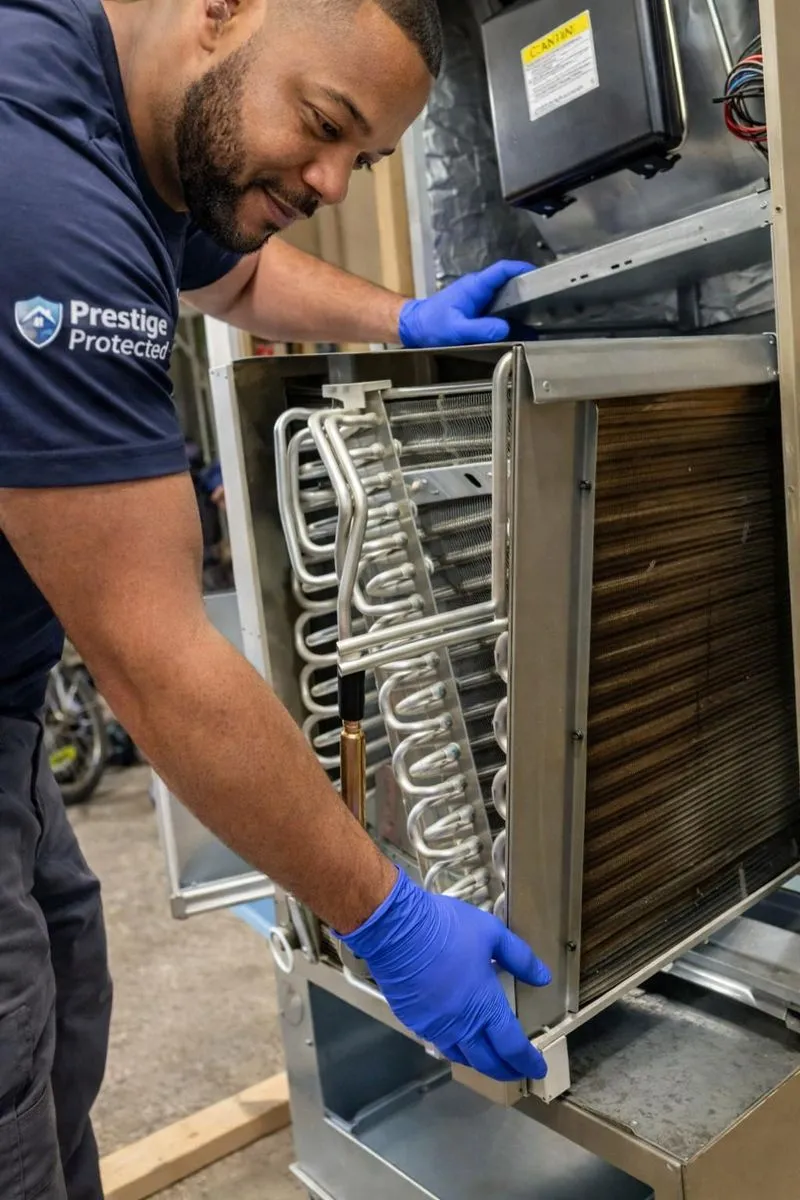
- The evaporator coil and drain pan. The coil is the coldest wet surface in the whole system, and everything downstream of it gets whatever grows there. A slow or blocked condensate drain keeps the pan full. This is the most common source we find, and it needs coil cleaning rather than duct cleaning.
- A leaking return in a damp space. Returns run under negative pressure, so any gap in a return duct passing through a humid crawl space or attic pulls that air straight into the system and distributes it to every room. The growth then shows up at registers far from the leak.
- Ductwork in an unconditioned attic. Cold supply air inside a hot humid attic condenses on the outside of the duct. If the insulation jacket is torn or compressed, the condensation soaks in and the growth is on the inner liner where you cannot see it.
- Whole-house humidity. An oversized air conditioner cools the house quickly and shuts off before it has removed much moisture. The room feels cold and the air stays wet. This is common in newer, tighter Triangle houses and it is a dehumidification problem, not a duct problem.
What is on your register may not be mold at all
Black or grey marks around a supply register are the reason most people search for this, and most of the time the marks are not mold. Three things look almost identical from a step ladder.
- Filtration soiling. Fine soot and dust deposited where air rushes past the edge of the register or around a gap in the ceiling. It smears when you wipe it and leaves a grey streak. Extremely common in Triangle homes with candles, a gas range or a fireplace.
- Ghosting. Dark lines that follow the framing or the register outline, caused by temperature differences and airborne particles rather than by growth. It does not smell.
- Actual mold. Usually speckled rather than smeared, often slightly raised, and almost always accompanied by a musty smell that gets stronger when the system starts. It reappears in the same pattern after you clean it.
The distinction matters because filtration soiling is a housekeeping and sealing problem, while mold is a moisture problem. If you cannot tell, photograph it and send it over, or ask for indoor air quality testing if you want a laboratory answer rather than an opinion.
Duct cleaning has never been shown to actually prevent health problems.
U.S. Environmental Protection Agency, Should You Have the Air Ducts in Your Home Cleaned? EPA
That is the honest ceiling on what a cleaning can promise, and it is why this page spends most of its length on finding the water rather than on selling the clean. The EPA does, separately, name visible mold growth inside ducts or on system components as one of the three situations where cleaning is warranted, and it is explicit that if the moisture problem is not corrected the growth will recur. Read the EPA guidance on duct cleaning alongside its brief guide to mold and moisture before you spend anything.
The right order of work
Doing this in the wrong order is the most expensive mistake in the whole subject, because you pay for the cleaning twice.
- Measure the humidity. Hallway and crawl space or basement, on a humid day.
- Find and stop the water. Condensate drain, coil, duct leaks, crawl space ground cover, bath and dryer venting.
- Remediate what has already grown, using containment where the affected area justifies it.
- Clean the system, so the debris that fed the growth leaves with it.
- Re-measure, and keep measuring through the first summer.
If you are at step three and want it handled locally, mold removal in Cary and mold removal in Raleigh cover the remediation side, and air duct cleaning in Cary or air duct cleaning in Raleigh covers step four.
For the Cary version of this, with local humidity numbers and what gets thrown away, see mold removal in Cary, NC.
Worried about duct mold? Get an inspection
Related guides
Why mold thrives in Triangle ductwork
Mold needs three things: spores (always present in air), a food source (dust and organic debris in ducts), and moisture. In Cary and Raleigh, moisture is the easy part, our summers routinely push outdoor dew points into the 70s, and every time humid air meets a cold surface inside your system, condensation forms. The dampest spot is the evaporator coil and the drain pan beneath it; uninsulated duct runs through crawl spaces and attics come second. Add a layer of dust as food, and a colony can establish itself in weeks.
- A/C coils and drain pans stay wet by design, if the drain clogs or the pan overflows, mold follows quickly
- Duct leaks in humid crawl spaces pull damp air into the system
- Oversized A/C units cool fast but dehumidify poorly, leaving indoor humidity high
- Any past roof or plumbing leak near ductwork can seed a problem that spreads through the system
How professional removal actually works
Treating visible spots with a spray does not solve duct mold, the EPA is clear that cleaning must be paired with correcting the moisture problem, or the growth returns. A proper job looks like this:
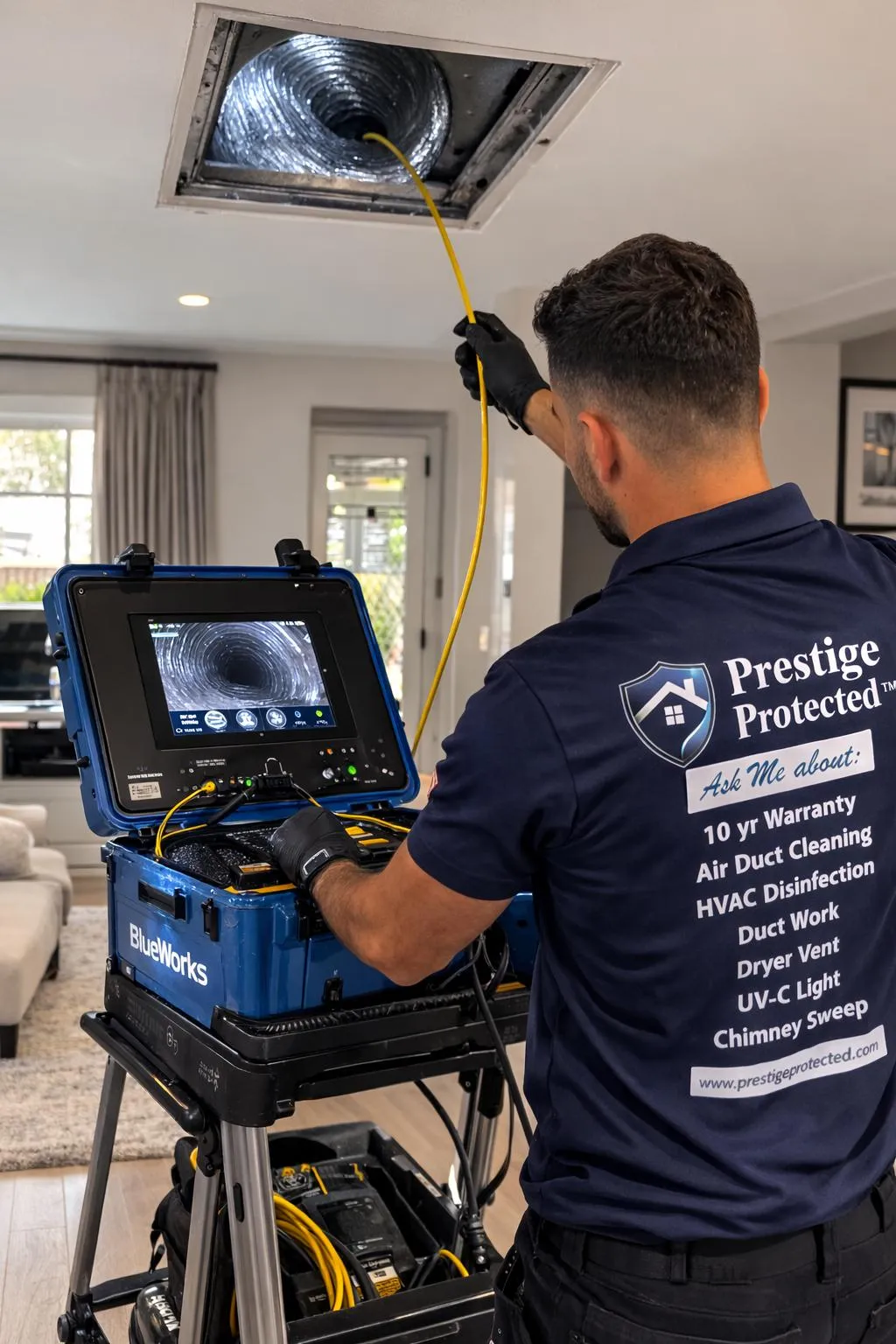
- Inspect and document. We photograph the growth and check the coil, pan, and duct runs to map how far it extends.
- Source-removal cleaning. Negative-air equipment and agitation tools remove the contamination and the dust it feeds on from the duct runs, not just the visible patch.
- Coil and pan cleaning. Because most duct mold traces back to the coil area, we clean it as part of the job, see our coil cleaning service.
- EPA-registered treatment. An antimicrobial applied to cleaned surfaces, used as a finishing step, never as a substitute for removal.
- Fix the moisture. We identify what got the system wet, clogged condensate drain, duct leak, humidity, and tell you plainly what needs correcting so the mold stays gone.
Keeping it from coming back
Keep indoor humidity below 60% in summer (a standalone hygrometer costs a few dollars), change filters on schedule, keep the condensate drain clear, and address musty smells early rather than masking them. If anyone in the home has been reacting to the air, indoor air quality testing can confirm whether spore levels have returned to normal after remediation. Related reading: musty smell from vents, mold removal in Cary and mold removal in Raleigh.
More common questions
Can I just spray the mold I can see and be done?
No. Visible growth at a register is usually the tip of a colony extending into the duct run, and spraying does nothing about the moisture that caused it. The EPA’s guidance is source removal plus moisture correction, otherwise it returns, often within a season.
What does mold in air ducts smell like?
Musty and earthy, like a damp basement or wet cardboard, and the giveaway is timing: it gets noticeably stronger in the first minute after the system starts and fades when it stops. A smell that is constant regardless of the system is more likely to be coming from a room, a crawl space or a drain.
Can I clean mold out of my air ducts myself?
You can wipe a register face, and that is worth doing. What you cannot do from outside is reach the branch duct, the plenum or the coil, and those are where the growth usually lives. Spraying a household cleaner or a fogger into a register also does nothing about the moisture that caused it, so the growth returns.
Does duct cleaning get rid of mold permanently?
Only if the moisture source is fixed at the same time. Cleaning removes what has grown and the debris feeding it. If the coil is still wet, the condensate drain still blocked, or the house still sitting above 60 percent humidity, the same growth returns within a season.
Is mold in air ducts a health emergency?
For most healthy adults it is a problem to solve rather than an emergency. People with asthma, allergies, a weakened immune system, or a chronic lung condition can react more strongly, and infants and older adults are more sensitive. If someone in the house has symptoms that improve when they leave and return when they come home, treat it as urgent and get the source found.
How much of the problem is the air conditioner coil?
Often most of it. The coil is the coldest wet surface in the system and everything downstream is exposed to whatever grows on it. We check the coil on every mold-related visit, and where the coil is the source, cleaning the ducts without cleaning the coil solves nothing.
Does this apply to Cary and Raleigh homes differently?
Not really. Both sit in the same humid subtropical climate with the same summer dew points, so the mechanism is identical. The difference is housing stock: older crawl space homes tend to have the moisture below the floor, and newer tighter homes tend to have it in the equipment and in the whole-house humidity level.
What to do next
If you have read this far you probably have a smell, a mark on a register, or both. The next step is not a cleaning quote, it is a humidity reading and a look at the coil and the drain pan. We do that first on every mold-related visit and we will tell you if the answer is a dehumidifier rather than us. Call (888) 404-8321 or request an inspection online, and if you already know which side of the Triangle you are on, start at mold removal in Cary or mold removal in Raleigh.