Quick answer
A Raleigh homeowner kept finding dust around their supply vents days after wiping them clean. Inside the ducts we found coated walls and settled debris narrowing the airflow, typical of a system several years past its last cleaning. A full source-removal cleaning of the supply and return runs fixed the recurring dust, documented with before-and-after photos.
What we found inside a Raleigh home’s ductwork
A Raleigh homeowner called us after dust kept collecting around several supply vents. They would wipe the covers down, and within days the dust was back, so they wanted to know what was actually happening inside the ducts.
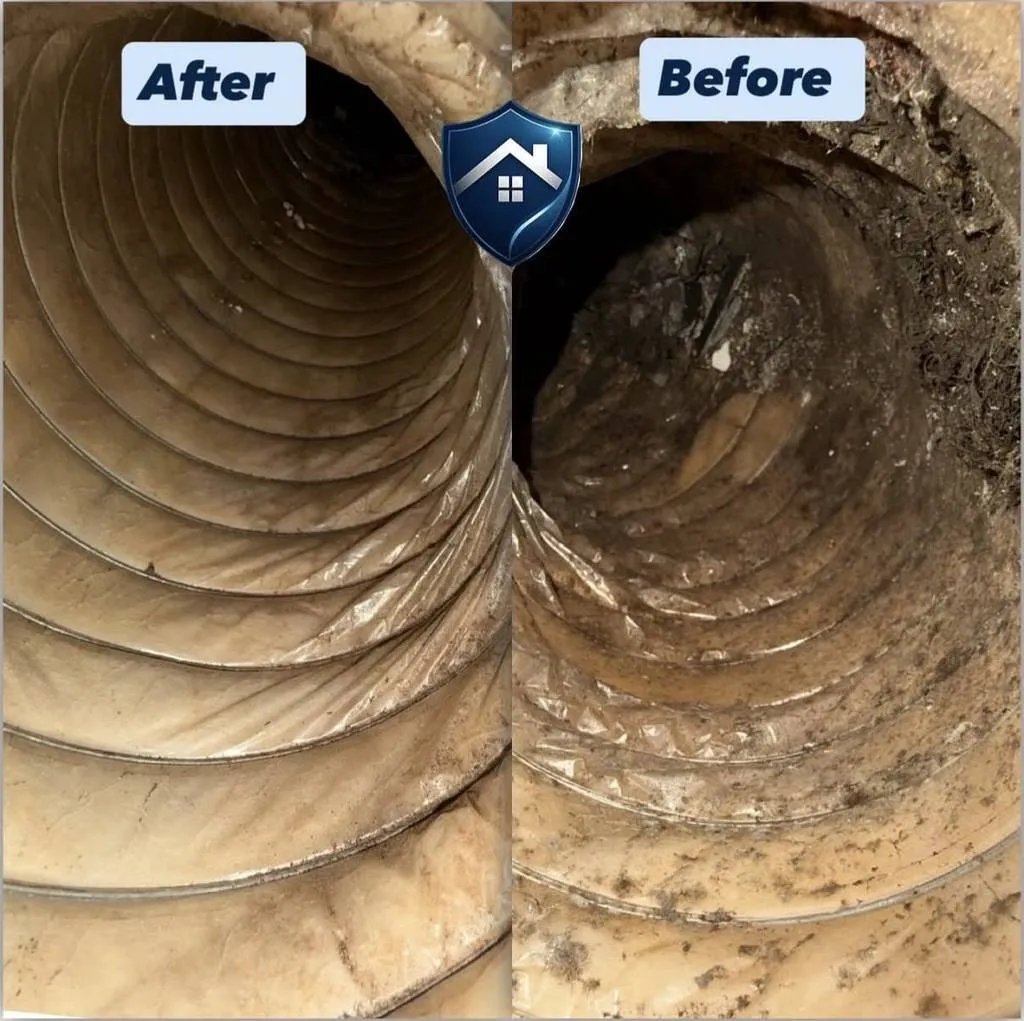
From the room it looked like ordinary household dust on the vent covers. Once we opened the system and inspected it, the picture changed. Dust coated the duct walls, loose debris had settled in the supply and return runs, and in a few spots the buildup had narrowed the airflow. Systems that go several years without a professional cleaning usually look like this.
How we handled it
We photographed the vents and ductwork before touching anything, so the homeowner could see the real condition instead of taking our word for it. Then we cleaned the accessible ductwork, the supply vents and the return areas, pulling out the packed dust and debris and working the spots where it had collected most heavily. We finished with before-and-after photos of the same runs.
Why this matters for Raleigh homes
Whatever sits in your ducts gets pushed back into your rooms every time the system runs. The U.S. EPA notes indoor air can be two to five times more polluted than the air outside, and Raleigh homes take on heavy spring pollen, humid summers, pet dander and renovation dust that all end up in the ductwork. Industry guidance suggests a cleaning every three to five years; homes with pets or allergy sufferers usually land at the shorter end.
We clean air ducts and dryer vents across Raleigh and the Triangle, including North Hills and Midtown (27609) and West Raleigh (27612). If you want to know what a job runs, see our Raleigh cost guide, or read more about our Raleigh air duct cleaning service.
If dust keeps returning around your vents, the airflow feels weak, or you cannot remember the last cleaning, an inspection will show you the real condition of your ducts before you decide on anything.
What buildup like this does to your air and your system
Dust settled in ductwork is not just a housekeeping nuisance. Every heating or cooling cycle picks some of it back up and delivers it to your rooms, which is exactly why this homeowner could never get ahead of the dust at the registers. Buildup thick enough to narrow a duct run also makes the blower work harder to push the same air, and a dirtier system loads the filter faster. The U.S. Department of Energy and ENERGY STAR both note that restricted airflow forces HVAC systems to run less efficiently; a clean filter inspected monthly and changed when it is dirty is the first defense, but it cannot capture what is already settled downstream of it.
What to expect if we inspect your Raleigh home
- Photos before anything else. You see the actual condition of your ducts, not a stock image or a scare story.
- An honest verdict. If the buildup does not justify a cleaning yet, we say so and tell you when to check again.
- Source-removal cleaning of the supply and return runs, registers and accessible trunks with negative-air equipment, not a quick vacuum at the vent covers.
- After photos of the same runs, so the before-and-after comparison is honest.
If your home has recurring dust, allergy flare-ups when the system runs, or has just been through a renovation, start with our guide to the signs your air ducts need cleaning or check what a Raleigh cleaning costs. We serve all of Raleigh and the Triangle.
Why the return side is almost always the problem
Homeowners think about supply vents because that is where air comes out and that is what they can see. The return is where a forced-air system does most of its collecting. Every particle the house generates, and every particle that comes in through a door on a Raleigh spring afternoon, eventually gets pulled toward the return grille. Anything the filter does not stop ends up downstream of it, which means in the blower compartment and on the coil.
That is why a cleaning that only does supply registers looks fine and changes nothing. The material was never mostly in the supplies. In this house the supplies were unremarkable and the returns were the story, which is the usual ratio rather than the exception.
What the coil had to do with the dust
The evaporator coil sits in the airstream and it is wet for most of a North Carolina summer. Fine dust that reaches it does not blow through, it sticks. A loaded coil restricts airflow, which makes the system run longer to reach the same temperature, which moves more air past the same debris. ENERGY STAR makes the same point about a clogged filter: restricted airflow makes the system work harder to do the same job.
So on a house like this one, cleaning ducts without cleaning the coil is doing the easy two thirds. We include the coil because leaving it is the single most common reason a cleaning does not hold.
What this job means for other Raleigh homes
- If dust returns within a week of cleaning surfaces, the source is being redistributed rather than tracked in. Look at the return side.
- A filter that grays out in under a month is telling you something about load, not about filter quality.
- Houses that have had renovation work, new flooring or drywall repair in the last couple of years are the ones where duct debris is usually worth checking.
- A crawlspace-mounted system in a Raleigh ranch collects differently from an attic system in a newer two-story. Neither is worse, but the access and the failure points differ.
- If nobody offers to show you the inside of the system on camera, there is no way to tell whether any of this applies to your house.
Where this job sits against the federal guidance
We are not going to pretend every house needs this. The EPA is specific about when duct cleaning is warranted, and this Raleigh home met the test: visible heavy deposits, a loaded coil, and a household symptom (recurring dust) that nothing else explained.
If no one in your household suffers from allergies or unexplained symptoms or illnesses and if, after a visual inspection of the inside of the ducts, you see no indication that your air ducts are contaminated with large deposits of dust or mold (no musty odor or visible mold growth), having your air ducts cleaned is probably unnecessary.
U.S. Environmental Protection Agency, Should You Have the Air Ducts in Your Home Cleaned?
Read that backwards and it tells you exactly what makes a job like this one worth doing. Symptoms in the house, plus something you can see on a visual inspection. Take either half away and we would have told this homeowner to save the money.
The wider context is worth one line. EPA exposure studies found indoor levels of common organic pollutants around two to five times higher than outdoor levels, and people spend roughly 90 percent of their time indoors. That is why a house that is visibly redistributing its own dust is worth fixing rather than living with.
One follow-up for anyone reading this with the same dust problem: our guide to which HVAC filter to use in a Cary or Raleigh home covers the half of the job that happens between cleanings.
Frequently asked questions
How do I know if my home’s air ducts need cleaning?
Common signs include visible dust blowing from registers, musty odors when the system runs, worsening allergy symptoms, and a system that has never been professionally cleaned.
What does professional air duct cleaning remove?
It removes the dust, pet dander, pollen and debris that build up in supply and return ducts over years and recirculate through your home every time the HVAC system runs.
How often should Raleigh homes have their air ducts cleaned?
The industry guidance suggests every three to five years for most homes. With Raleigh’s pollen and humidity, plus pets or a recent renovation, many homeowners are better served at the shorter end of that range.
How do I know if my recurring dust is a duct problem?
The tell is dust that returns to the same registers within days of cleaning, or visible streaks radiating from supply vents. Dust that appears evenly everywhere is usually ordinary household dust; dust concentrated at the vents points to the system. An inspection with photos settles it definitively.
How long does a job like this Raleigh cleaning take?
Most single-system Raleigh homes take three to five hours for a genuine source-removal cleaning. Larger two-system homes take longer. Any crew that finishes a whole house in under an hour has cleaned the vent covers, not the ducts.
Will one cleaning stop the dust for good?
It removes what years of buildup put into the system, which is what feeds recurring vent dust. How long it stays clean depends on filtration habits, pets, and renovation activity. For most Raleigh homes a cleaning holds for several years with regular filter changes.
Was anything found in this house that was not cleaning?
Nothing structural. The runs were intact and the boots were sealed, so this was a cleaning job rather than a repair job. When we do find a disconnected run or damaged flex, we say so, photograph it and quote it separately, because it is a different piece of work.
How long did this Raleigh job take?
Most of a working day for two technicians, because the returns and the coil were the heavy part. A house with a similar vent count and a system in better condition is usually faster.
Would a cheaper cleaning have fixed this?
Not the way the problem presented. A supply-only pass would have left the returns and the coil, which is where the material was. The homeowner would have paid less and been calling somebody again by the following season.
How do I find out whether my Raleigh home looks like this one?
Pull the largest return grille and look at the first couple of feet with a phone light. That one look answers the question for most houses, and it costs nothing.
Related reading
- Air duct and dryer vent cleaning in Raleigh, NC
- Air duct and dryer vent cleaning in Cary, NC
- Why is my house so dusty?
- Black dust around air vents
- Air duct cleaning cost in Raleigh, NC
- How our cleaning process works
Last updated by the Prestige Protected service team.
Book an air duct inspection in Raleigh
Same-day availability across Raleigh and the Triangle, call (888) 404-8321.