Quick answer
Air duct cleaning needs about fifteen minutes of preparation from you, and nothing you have to buy. Clear a three-foot path to every supply and return vent, clear the door to the closet, attic hatch or crawlspace where the air handler sits, put pets in a room we are not working in, and plan for two to five hours of real noise with someone home at the start and the finish.
Air duct cleaning needs about fifteen minutes of preparation from you. Not two hours of moving furniture, and nothing you need to buy. But the fifteen minutes matter, because the most common cause of a slow or partial cleaning is a technician who cannot physically reach half the vents.
Here is exactly what to do before we arrive, and what you can safely ignore.
The short version
Clear a three-foot path to every supply and return vent. Clear the door of the closet, attic hatch or crawlspace where your air handler lives. Put pets in a room we will not be working in. Plan for someone to be home. Expect two to five hours and real noise.
That is the whole list. The rest of this page explains why each one matters.
1. Clear access to every vent
This is the one that actually changes the outcome. A typical Triangle home has between eight and twenty supply registers plus one or two large returns, and every one has to be opened, brushed and vacuumed.
Walk the house and look at floor level. Sofas and beds pushed over floor registers, boxes stacked in front of a return, a chest of drawers against a wall vent, rugs laid across floor vents. You do not need to move heavy furniture out of the room, just far enough that the grille can be unscrewed and a brush fed into the duct.
Ceiling registers are usually fine, but if a tall bookcase sits directly beneath one, shift it.
2. Clear the way to the air handler
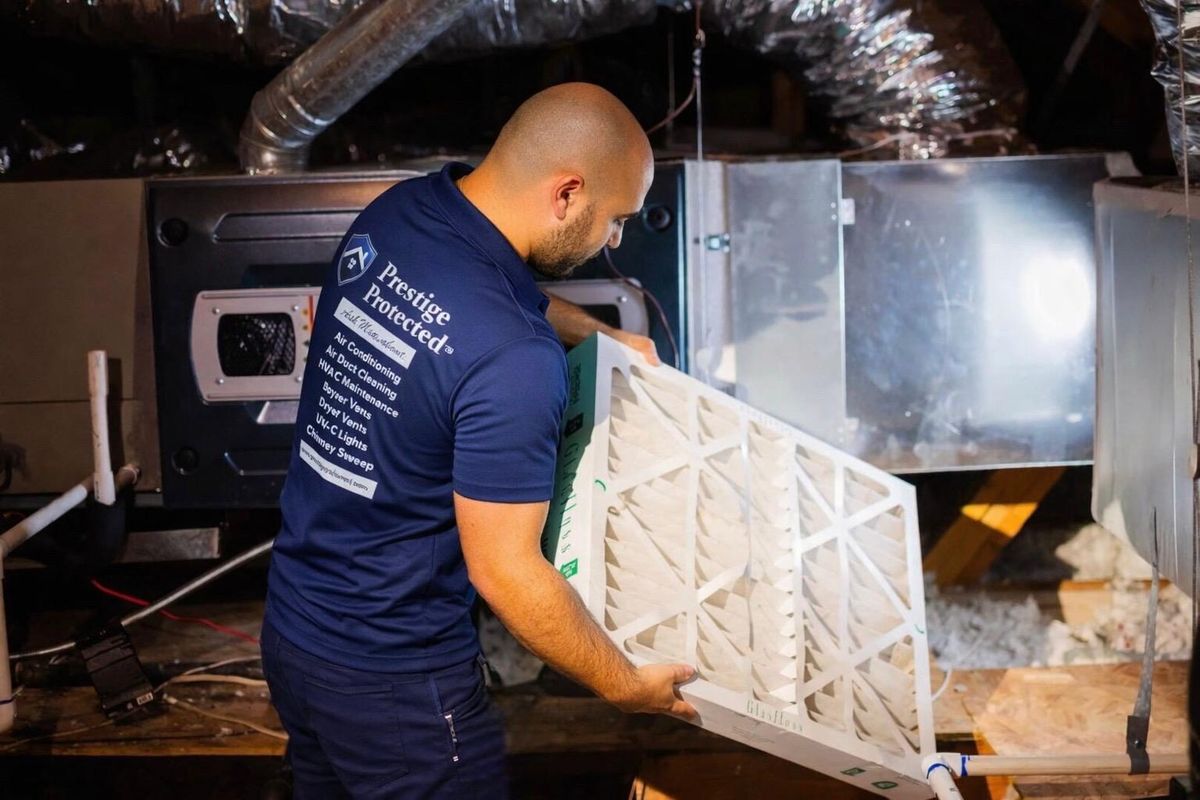
The air handler is where the negative-air machine connects, and it needs a working space rather than a gap. In Triangle homes it is normally in a hallway closet, the garage, the attic or the crawlspace.
Closet: empty the floor. Attic: clear the hatch and anything stacked under it. Crawlspace: unlock the access door and move whatever is parked in front of it. Garage: leave a clear route from the driveway.
3. Plan for pets and small children
The equipment is loud, doors get propped open, and hoses run through the house for hours. Put pets in a room we will not be working in and tell us which one.
This matters more with cats than dogs, because an open exterior door and a startled cat is the one genuinely bad outcome of a duct cleaning appointment.
4. Does someone need to be home?
Yes, for the start and the end at minimum. At the start we walk the house with you and confirm what is included. At the end we show you photographs of your own ducts, before and after.
If you cannot be there the whole time, be there for those two moments. The handover is the part that tells you whether you got what you paid for.
5. How long, and how loud
Two to five hours for most single-system Triangle homes. Two systems, or a house over about 3,000 square feet, can run longer. Our air duct cleaning process page breaks down how long each stage takes.
It is genuinely loud. The vacuum is a truck-mounted or cart-mounted unit, not a shop vac. If you work from home, schedule calls around it or plan to be out. If there is a baby napping, tell us and we will sequence the rooms around it.
6. What we bring, and how we protect your home
Negative-pressure containment, so debris is pulled into a sealed unit instead of into your rooms. Rotary brushes and air whips sized to your ducts. Drop cloths at the air handler and at every access point. Shoe covers. This is what a full air duct cleaning service includes as standard.
You should not need to clean up after us. If you do, something went wrong, so tell us before we leave.
7. What you do not need to do
Do not vacuum or dust beforehand, because we are about to disturb far more than you could. Do not buy a new filter; ask us what size you need and fit it after. Do not turn the system off in advance, as we will shut it down and isolate it ourselves. And do not move heavy furniture. Just clear the vents.
8. Crawlspace and attic systems in Triangle homes
A lot of Cary and Raleigh housing stock runs ductwork through a vented crawlspace or an unconditioned attic, and two things follow from that.
Access is the variable that moves the timeline most. A crawlspace with low clearance and a locked door adds time before any cleaning starts, so unlocking it in advance genuinely shortens the appointment.
And in our humidity, crawlspace ducts are where we most often find moisture damage or disconnected runs. That is a repair conversation rather than a cleaning one. If that is your setup, expect us to photograph what we find and talk to you before doing anything else.
Booking from our Cary or Raleigh office
We run two Triangle offices. Our Cary office is at 150 Preston Executive Dr and covers Cary, Apex, Morrisville and Holly Springs. Our Raleigh office is at 4913 Professional Ct and covers Raleigh, Garner, Wake Forest, Knightdale and Durham. Both reach us on (888) 404-8321.
Not sure where your air handler is, or how many vents you have? Send a photo of the closet or the crawlspace hatch and we will tell you what access we will need before the appointment, so nothing slows the job down on the day.
What the day actually looks like, hour by hour
Preparation is easier when you know the shape of the visit. A typical Raleigh or Cary house with one system runs something like this, and knowing it tells you what to clear and when to be available.
- First twenty minutes: we walk the house, count and confirm the registers, find the air handler, and put down protection on floors and at the doorway.
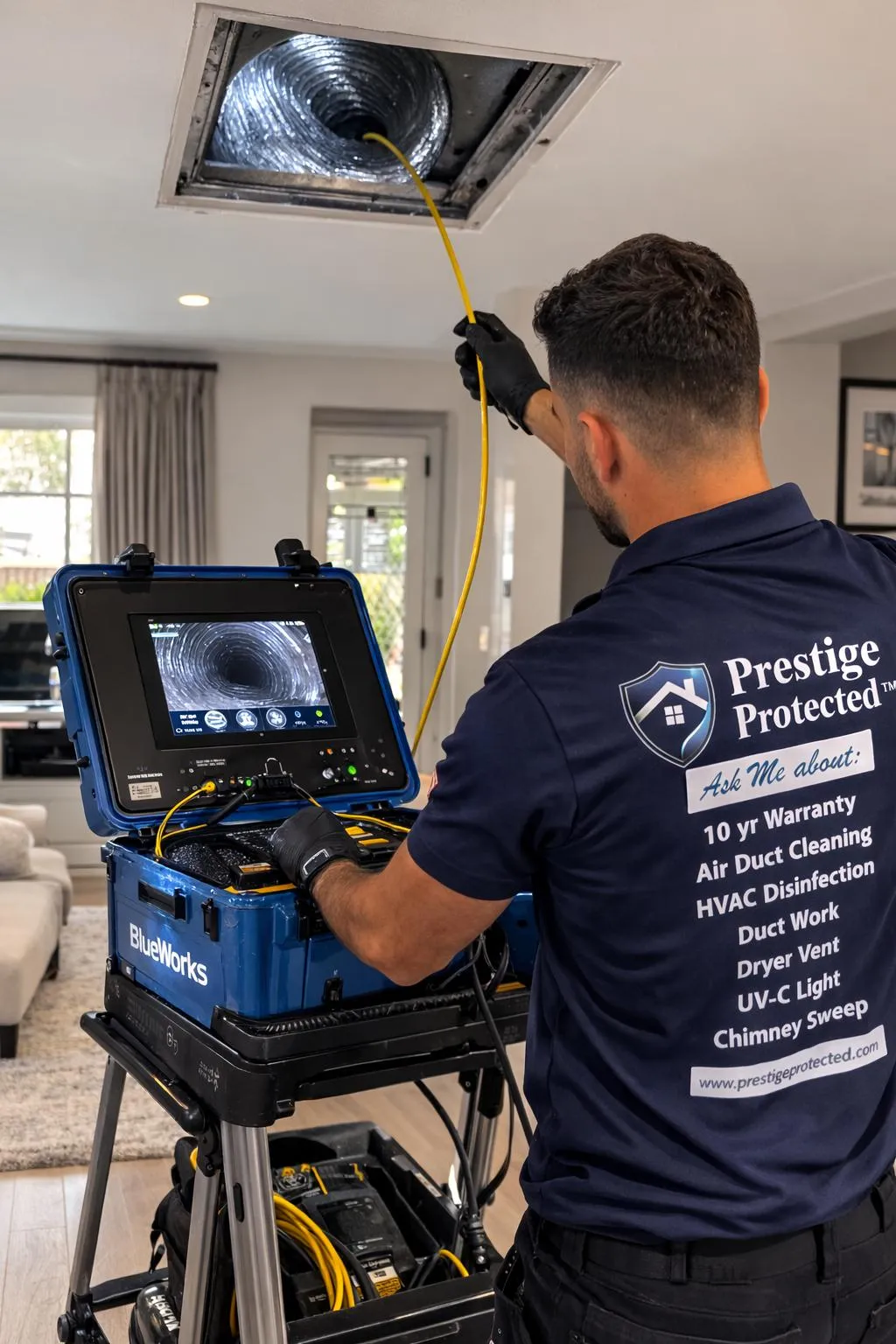
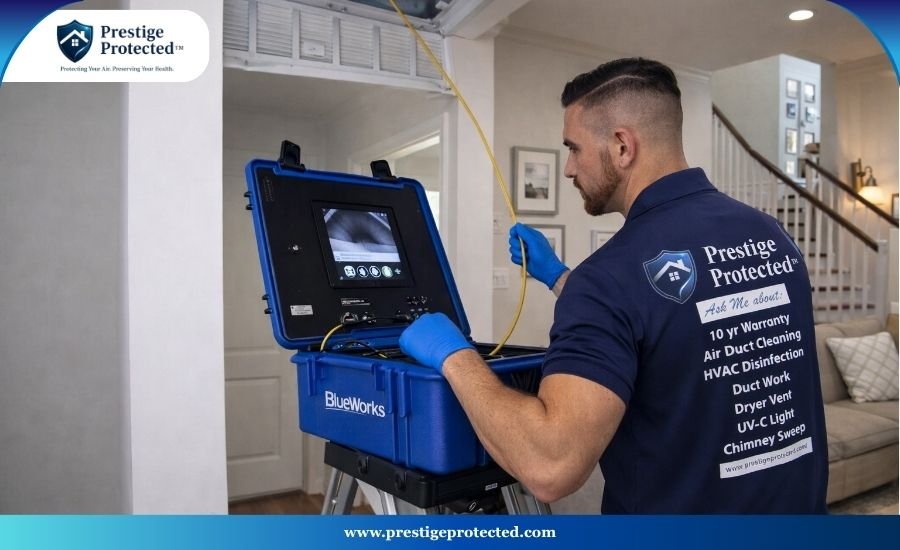
- Next twenty minutes: the camera goes in before anything is cleaned, and you get shown what is actually in the system. This is the point at which you can ask questions or change the scope.
- The bulk of the visit: the vacuum is connected, and each run is brushed and drawn out, register by register. This is the loud part, comparable to a shop vacuum running in the hallway.
- Then the return side and the air handler, which is usually the dirtiest single stage and the one that takes the longest on a neglected system.
- Last half hour: the after photographs, an airflow check at the registers and at the dryer termination if the vent was part of the job, and a walk-through of what was found.
The three access problems that actually cost time
Almost nothing a homeowner forgets to do matters much. Three things do, and all three are about reaching something rather than tidying anything.
- A blocked air handler. Closets get used for storage. If the unit is behind boxes, shelving or a stacked washer and dryer, that has to come out before the largest part of the job can start.
- A crawlspace hatch that will not open. Older Raleigh ranches often have a hatch nobody has lifted in years, sometimes behind a deck or a shrub. Worth checking the week before rather than on the day.
- An attic pull-down in a closet full of clothes. Attic systems are common in newer Cary and North Raleigh construction, and the ladder needs about three feet of clear floor to come down safely.
Furniture over a floor register is a two-second problem for the technician. A locked crawlspace is a rescheduled appointment. Those are not the same category, which is why the list above is short.
What you genuinely do not need to do
You do not need to clean before we arrive, you do not need to buy a filter in advance, and you do not need to take the whole day off if the house has a single system and reasonable access. You also do not need to move heavy furniture. The crew carries protection for floors and doorways, and moving things is part of the job rather than something you owe us in advance.
Worth reading before the visit
If you have booked a cleaning and you are having second thoughts about whether it was necessary, read the federal guidance rather than our sales page. It is short and it is not written to sell you anything.
If no one in your household suffers from allergies or unexplained symptoms or illnesses and if, after a visual inspection of the inside of the ducts, you see no indication that your air ducts are contaminated with large deposits of dust or mold (no musty odor or visible mold growth), having your air ducts cleaned is probably unnecessary.
U.S. Environmental Protection Agency, Should You Have the Air Ducts in Your Home Cleaned?
If that paragraph describes your house, tell us when we arrive. The camera inspection happens before any cleaning starts precisely so that conversation can still happen with the equipment on the driveway rather than in your hallway. We would rather walk away from a job than take payment for one nobody needed.
If it does not describe your house, the preparation above is all that is left to do. EPA exposure work puts indoor levels of common organic pollutants at roughly two to five times outdoor levels, and people spend about 90 percent of their time indoors, so the fifteen minutes of clearing access is a reasonable trade.
While you are waiting for the visit, it is worth checking what is in the filter slot. Our guide to which HVAC filter to use in a Cary or Raleigh home covers the rating, the fit and how often to change it.
Frequently asked questions
Is air duct cleaning messy?
It should not be. Negative pressure means debris goes into a sealed vacuum rather than into your rooms. Some dust at the register faces is normal, and we wipe those down before we leave.
Do I need to be home the whole time?
No, but be there at the start and at the finish. The start is when we walk the house and agree the quote, and the finish is when we show you the photos.
Can you work around a nap or a work call?
Yes, if you tell us at the walkthrough. We can sequence the rooms so the noisy part is not happening next to a closed door.
Should I change my filter before you come?
After, not before. A new filter installed before the visit collects the dust we are about to disturb. Ask us for the size while we are there.
How do I know the job was done properly?
Ask for photographs of the inside of your own ducts, before and after. Not stock images, and not just the register faces. Any company should be able to produce them.
How long does the appointment take?
Two to five hours for most Triangle homes, depending on the number of systems and vent openings. A dryer vent on its own is usually 30 to 90 minutes.
Do I need to move furniture?
Only what blocks a vent. Clear a three-foot path to every supply and return opening. Nothing else needs to move.
What if you cannot reach the air handler?
Then part of the job cannot be done, which is why the closet, attic hatch or crawlspace access matters. Send us a photo beforehand if you are unsure and we will tell you what access we need.
Do I need to turn the HVAC system off before you arrive?
No. We will shut it down as part of the setup and restart it when the work is finished and the airflow has been checked.
Will the house be dusty afterwards?
It should not be. The system runs under negative pressure while the runs are being brushed, so the debris goes into the collection unit rather than into the room. Floor and doorway protection covers the rest.
Can you come on a weekend?
Weekend slots exist and they book further out than weekdays. If access involves a crawlspace or an attic, say so when you book so we allow the right amount of time.
What if it turns out my system does not need cleaning?
Then we tell you during the camera inspection, before any work starts, and you are free to stop there. We would rather lose one job than sell you work you did not need.
Do I need to be home for the whole visit?
You need to be there at the start, for the walk-through and the camera inspection, and at the end for the after photographs. The middle stretch is just equipment running, and plenty of customers work through it in another room.
Related reading
- Air duct and dryer vent cleaning in Raleigh, NC
- Air duct and dryer vent cleaning in Cary, NC
- How our air duct cleaning process works
- What air duct cleaning costs
- Signs your air ducts need cleaning
- How to choose a duct cleaning company
Last updated by the Prestige Protected service team.
Ready to book, or not sure about access?
Send a photo of the air handler closet or crawlspace hatch and we will tell you exactly what access we need before the day.