
TL;DR: Quick Answer
Most Raleigh homeowners quoted for full ductwork replacement do not need it. Replacement is genuinely warranted when ducts are crushed, disconnected, saturated, contaminated beyond cleaning, badly undersized, or when the whole system is being changed anyway. Surface rust on sheet metal, dust, weak airflow at one register and a musty smell usually have cheaper causes. Get the system inspected before you accept a replacement quote. Prestige Protected does not sell ductwork replacement, so our inspection has nothing to sell you. Call (888) 424-6285.
Last updated by the Prestige Protected service team.
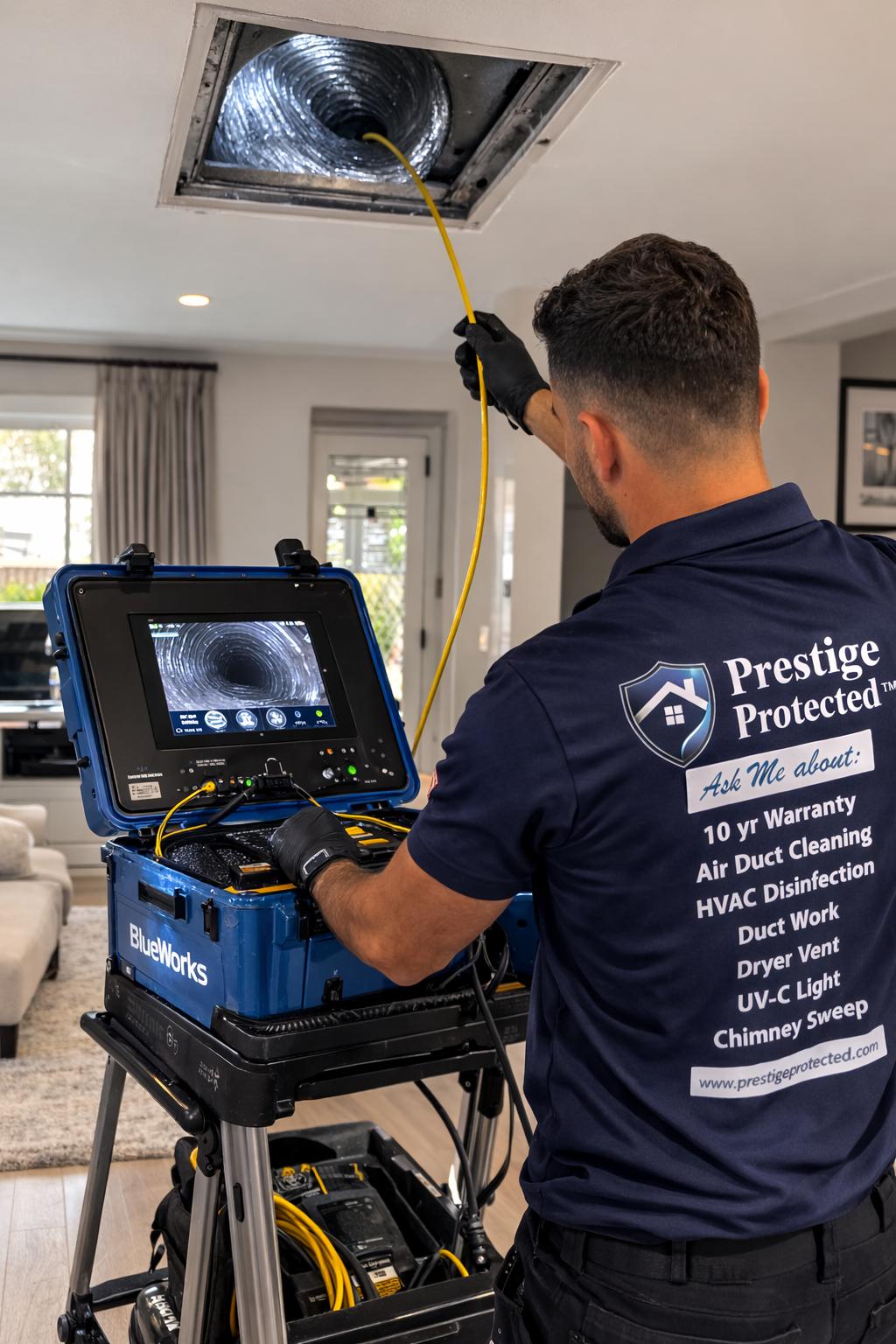
If someone has told you that your Raleigh home needs its entire duct system replaced, slow down and get it looked at by somebody who does not sell duct replacement. Full replacement is a serious, expensive job that is occasionally the right answer and frequently sold when it is not. This guide explains what genuinely fails, what only looks like failure, how flexible and rigid duct actually compare, and how to line up three estimates that you can read side by side.
Do rusting metal ducts need to be replaced?
Older Raleigh homes, particularly inside the Beltline and across the mid-century neighborhoods around Midtown and North Hills, often have galvanized sheet metal trunk lines. Homeowners see orange staining on a seam and assume the system is finished. Usually it is not.
What to look at instead of the color:
- Is the metal intact? Surface oxidation on galvanized steel is cosmetic. Rust that flakes, or that has eaten through so a screwdriver handle taps through the wall of the duct, is not.
- Why is it wet? Rust on a duct means condensation, and condensation means either failed insulation on that run or a humid crawlspace or attic around it. Replacing the duct without fixing that gives you a new duct that rusts.
- Is it the duct or the plenum? The plenum and the first few feet off the air handler take the most moisture. A localized repair there is a fraction of a whole-house replacement.
- Is the insulation wet or moldy? Duct board and the fibrous liner inside some older systems cannot be cleaned once they are saturated or contaminated. That specific material is one of the honest reasons to replace a section.
Bare sheet metal in decent condition can last decades in a Raleigh home. Flexible duct is the shorter-lived component, especially where it has been kinked around a joist, compressed by storage in an attic, or left sagging in a crawlspace where it collects moisture.
Flexible or rigid duct: which is better for a Raleigh home?
This is the comparison most estimates gloss over, so here it is plainly.
| Flexible duct | Rigid sheet metal | |
|---|---|---|
| Installed cost | Lower. Cheaper material, much faster to run. | Higher, and most of the gap is labor, because every joint is fabricated and sealed on site. |
| Airflow | Corrugated interior creates friction; sharp bends and slack runs lose a lot. | Smooth walls move air more efficiently. |
| Service life | Shorter. Heat, compression and moisture age it fastest in attics and crawlspaces. | Well-installed metal frequently outlasts several sets of equipment. |
| Cleanability | Can be cleaned carefully; an aggressive tool tears the inner liner. | Cleans well and repeatedly. |
| Best use | Short, gently curved branch runs to registers. | Trunk lines carrying the volume. |
- Installed cost. Flexible duct is cheaper to buy and much faster to run, which is why nearly every Raleigh house built in the last thirty years uses it for branch runs. Rigid sheet metal costs more in labor because every joint is fabricated and sealed.
- Airflow. Rigid metal has smooth walls and moves air more efficiently. Flex duct has a corrugated interior that creates friction, and it loses far more when it is bent sharply or left slack. A long, sagging flex run is a real cause of a room that never gets comfortable.
- Service life. Well-installed rigid duct commonly outlives the equipment attached to it. Flex duct has a shorter practical life, and its inner liner and outer jacket are what degrade first, particularly in a hot attic.
- Cleanability. Rigid metal cleans well and repeatedly. Flex duct can be cleaned carefully, but an aggressive tool can tear the inner liner, which is why the state of your flex runs belongs in the inspection conversation.
- Where each belongs. Most well-designed systems use both: rigid trunk lines carrying the volume, short and gently curved flex runs to the registers. A quote that proposes replacing everything with one material, in either direction, deserves a question about why.
Signs a Raleigh duct system may genuinely need replacing
Six conditions genuinely justify replacing a Raleigh duct system. Everything else on this page is cheaper.
- Ducts that are crushed, torn, or disconnected from a boot or plenum, so conditioned air is being delivered into a crawlspace or attic.
- Porous internal liner or duct board that has been soaked or has mold growth in the material itself, which cleaning cannot resolve.
- A system that has stood in flood water or sewage.
- Ducting that is clearly undersized or badly routed for the equipment, where no amount of cleaning or sealing will fix the airflow.
- Rodent or pest infestation in the material rather than simply in the space around it.
- You are replacing the furnace and air handler anyway, and the duct design has to change to suit the new equipment. This is the cheapest moment to do duct work, because everything is open.
Signs that usually point somewhere cheaper
- High energy bills. ENERGY STAR states:
In a typical house, however, about 20 to 30 percent of the air that moves through the duct system is lost due to leaks, holes, and poorly connected ducts.
That is a sealing problem, not a replacement problem, and sealing is a fraction of the cost. - One room that never gets comfortable. Far more often a closed or blocked damper, a crushed flex run, a disconnected boot or a badly balanced system than a failed duct network.
- Dust everywhere. Check the filter, the filter seal and whether the return is pulling unfiltered air from a crawlspace before you consider the ducts finished.
- A musty smell. Usually the coil, the drain pan or a wet crawlspace. See mold removal in Raleigh for how that gets diagnosed.
- Visible dust at the registers. That is what air duct cleaning addresses. It is not evidence of a system at end of life.
What drives the cost of a full duct replacement
We do not quote duct replacement, so we will not print a price we cannot stand behind. What we can tell you is what moves the number in a Raleigh house, so an estimate stops being a mystery:
- Access. A walkable attic or a tall crawlspace is straightforward. A tight crawl, a finished basement ceiling or ducts buried in a slab or chase changes the labor dramatically.
- Material and design. Rigid metal costs more in labor than flex. A redesigned trunk layout costs more than a like-for-like swap.
- Number of runs and system count. Many Raleigh two-story homes have two systems, and a quote covering both is a different job to one covering the downstairs only. Check which you were given.
- Repairs behind it. Drywall, insulation, and any moisture correction in the crawlspace or attic are usually separate lines and are frequently missing from the cheapest estimate.
- Load calculation. A contractor who sizes the new system properly is doing more work than one who copies the old layout, and that shows in the price. That is worth paying for.
How to get three Raleigh estimates that you can actually compare
- Get an independent inspection first. Have someone who does not sell replacement look at the system and photograph it, so every contractor is bidding on the same described condition.
- Write your own one-page scope. Number of systems, which areas, material preference, whether repairs and moisture work are included, and whether a load calculation is required. Send the same page to all three.
- Insist on itemized estimates. Materials, labor, sealing, insulation, permits where applicable, repairs and disposal, each on its own line. One lump sum cannot be compared to anything.
- Check the license. Duct replacement is HVAC contracting work. Ask for the North Carolina license number and verify it with the N.C. State Board of Examiners of Plumbing, Heating and Fire Sprinkler Contractors, and ask for the certificate of insurance directly from the insurer.
- Ask what happens to the moisture. If the reason the old ducts failed was a wet crawlspace or attic, and no estimate mentions it, all three are quoting the same future problem.
- Be skeptical of the same-day discount. A price that expires this afternoon is a sales tactic, not a quote. Read the common duct scams before you sign anything.
Where we fit, honestly
Prestige Protected does not install or replace ductwork, and we do not sell duct sealing. This page is informational for that reason: we have nothing riding on the answer. What we do is clean air ducts and dryer vents, repair and replace dryer vent lines, inspect HVAC systems, test indoor air quality, clean coils, sanitize, and remediate mold, across Raleigh and the Triangle.
That makes us a useful second opinion. We can inspect and photograph the inside of your system and tell you what we see: whether the ducts are intact, whether the liner is wet or contaminated, whether a run is crushed or disconnected, and whether what you are looking at is a cleaning job, a repair for an HVAC contractor, or a genuine case for replacement. If it is the last one, we will say so and you will take that to a licensed HVAC contractor.
Related reading: air duct cleaning versus duct replacement, cleaning versus duct sealing, the same question for Cary homes, and our HVAC inspection service. See everything we cover on the Raleigh air duct and dryer vent cleaning page.
Frequently asked questions
Do I need a complete air duct replacement in my Raleigh house?
Probably not, unless the ducts are crushed, disconnected, saturated, contaminated in the material itself, badly undersized, or the whole system is being replaced anyway. Weak airflow, dust and high bills usually trace to leaks, a blocked damper, a crushed flex run or a filter problem. Have the system inspected and photographed by someone who does not sell replacement before you accept a quote.
My old metal ducts are rusting. Does that mean they have to go?
Not on its own. Surface oxidation on galvanized steel is cosmetic. What matters is whether the metal has been eaten through, whether the insulation around it is wet, and above all why there is condensation on that run. Fix the moisture or a new duct will do exactly the same thing.
What is the cost difference between flexible and rigid ducts in Raleigh?
Rigid sheet metal costs more, and most of that gap is labor, because every joint is fabricated and sealed on site. Flexible duct is cheaper and much faster to install. Rigid moves air more efficiently, lasts longer and cleans better. Flex is fine for short, gently curved branch runs and poor when it is kinked, compressed or left sagging. Ask each contractor to price the design they recommend rather than a material, and to show the cost per system.
Can Prestige Protected replace my ductwork?
No. We do not install or replace ductwork and we do not offer duct sealing. We clean air ducts and dryer vents, repair and replace dryer vent lines, inspect HVAC systems, test indoor air quality, clean coils, sanitize and remediate mold. For replacement you want a licensed North Carolina HVAC contractor, and we are happy to give you a photographed inspection to take to them.
How do I get three comparable estimates for duct replacement in Raleigh?
Have the system independently inspected and photographed first, write a one-page scope covering number of systems, areas, material, repairs and whether a load calculation is required, then send that identical page to all three. Require itemized pricing rather than a lump sum, verify each license and insurance certificate, and check that every estimate addresses the moisture that caused the problem.
Would sealing my ducts fix high energy bills instead?
Often. ENERGY STAR puts the loss in a typical house at about 20 to 30 percent of the air moving through the duct system, lost to leaks, holes and poorly connected ducts, and sealing costs a small fraction of replacement. We do not perform duct sealing, so this is a job for an HVAC or building performance contractor, but it belongs on the list before replacement does.
How long does ductwork last in a Raleigh home?
Well-installed rigid metal frequently outlasts several sets of equipment. Flexible duct is the shorter-lived part, and heat, compression and moisture shorten it further, which is why attic and crawlspace runs age fastest here. Condition matters far more than age, which is why an inspection settles it and a calendar does not.
Should I clean the ducts if I am replacing them soon?
If replacement is genuinely happening within a few months, no. Spend the money on the new system instead. If replacement is a maybe, or a year or more out, cleaning and inspecting first often changes the answer, because a photographed interior tells you whether you are looking at dirt or at damage.
Related reading
Get a second opinion before you replace
We inspect and photograph the inside of your Raleigh duct system and tell you what we actually see. We do not sell duct replacement.