
Quick answer
For most Cary and Raleigh homes, the right HVAC filter is the highest MERV rating your system can take without choking airflow, and the EPA recommendation is at least MERV 13 where the equipment allows it. A one-inch filter slot on an older system often cannot, and forcing a very dense filter into one does more harm than good. Check the filter monthly, change it at least every three months, and make sure it fits the slot with no gap around the edges. The gap matters more than the rating.
Filters are the cheapest thing in your heating and cooling system and the one that changes indoor air the most per dollar. They are also the part people get wrong most often, usually by buying a filter that is too dense for the equipment, or by buying the right filter and leaving it in for a year.
This page explains what the MERV number means, which rating actually suits a Triangle home, and the two mistakes that undo the whole thing. We clean duct systems for a living, and a good filter reduces how often that is worth doing. We would rather tell you that than not.
What MERV actually measures
MERV stands for Minimum Efficiency Reporting Value. It is a standardized scale, running from 1 to 16 for the filters you can buy for a house, that describes how well a filter captures particles in specific size ranges during testing. A higher number means the filter stops more of the small stuff.
Filters with a MERV of 13 and above are required to demonstrate at least 50% removal efficiency for the smallest particles tested.
U.S. Environmental Protection Agency, What is a MERV rating?
Two other scales exist on the shelf beside it. Some manufacturers print MPR, others print FPR, and both are proprietary house scales rather than the ASHRAE standard. MERV is the one that lets you compare across brands, so it is the number worth finding on the box.
| MERV range | What it catches | Where it makes sense |
|---|---|---|
| 1 to 4 | Large lint and carpet fibers | Equipment protection only. This is a screen, not a filter. |
| 5 to 8 | Mold spores, dust mite debris, most household dust | Older systems with a one-inch slot and limited fan capacity |
| 9 to 12 | Fine dust, some pollen fractions, pet dander | The practical sweet spot for a lot of Triangle homes |
| 13 to 16 | Smoke particles, fine airborne matter, bacteria-sized particles | EPA’s recommendation where the system can take it, ideally in a four or five inch media cabinet |
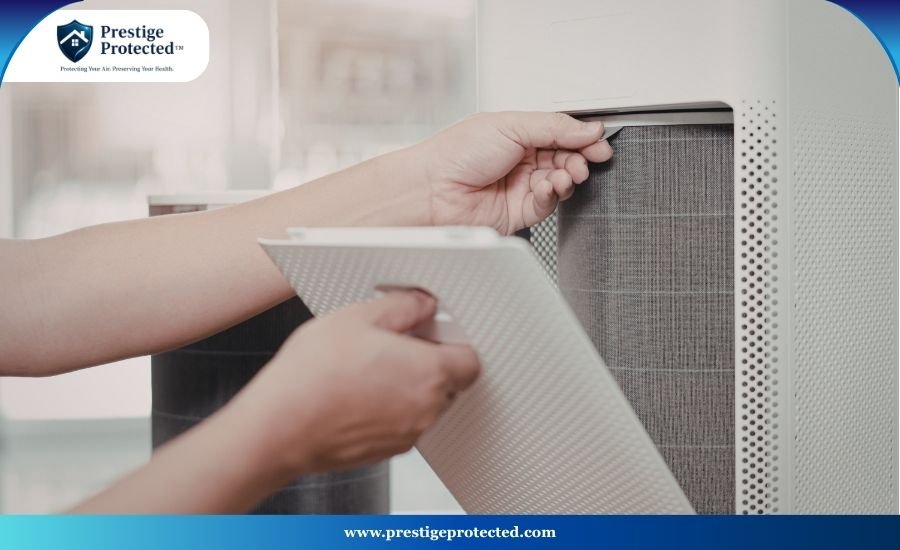
The EPA recommendation, and the caveat that comes with it
The EPA position is to use a filter rated at least MERV 13, or as high as the system will accommodate. The second half of that sentence carries as much weight as the first. A dense filter in a system that cannot pull air through it does three bad things at once: it starves the blower, it drops airflow across the coil, and it encourages air to find its way around the filter instead of through it.
In practice, a modern system with a four or five inch media cabinet handles MERV 13 comfortably. A twenty year old air handler with a one-inch slot and a tired blower often does not. If you are unsure which you have, the depth of the filter slot tells you most of it, and an HVAC technician can tell you the rest in a few minutes.
The two mistakes that matter more than the rating
- Leaving it in too long. A loaded filter restricts airflow whatever it says on the box. Check it monthly and change it at least every three months. In a Triangle house with pets, or during heavy pollen weeks in spring, monthly is not excessive.
- A filter that does not seal. If there is a gap between the filter and the frame, air takes the gap, because air always takes the easy route. A perfectly sealed MERV 8 outperforms a MERV 13 with a half-inch gap down one side. Buy the size that fits the slot, do not bend it to make it go in, and check the arrow points toward the blower.
How filters and duct cleaning relate
This is where we have to be careful, because we sell one of these things. A filter stops material before it gets into the system. Duct cleaning removes material that is already in there. They solve different halves of the same problem, and neither substitutes for the other.
The practical sequence for most Cary and Raleigh homeowners is: get the filter right first, run it for a season, and see whether the dust problem goes away. If it does, you have saved yourself a cleaning. If it does not, the material is already in the system and a camera inspection will show you whether it is worth removing. That order costs you a filter and a few months, and it means you never pay for a cleaning you did not need.
Filters in a Triangle house, specifically
- Spring pollen. Central North Carolina pollen loads are heavy enough that a filter can go from clean to visibly yellow in weeks. Check it in April rather than trusting the calendar.
- Crawlspace systems. Older Raleigh homes with ducts under the house pull humid air across everything. Filters last about as long, but moisture at the coil is the thing to watch.
- Attic systems. Common in newer Cary and North Raleigh construction. The filter is often at the return grille rather than at the unit, which makes it easier to check and easier to forget.
- Two systems, two filters. Plenty of Triangle houses run separate upstairs and downstairs units. It is very common to find one filter religiously changed and the other untouched since the house was built.
- Renovation work. If anybody has been sanding drywall, change the filter when they finish and again a month later. Construction dust arrives faster than any schedule anticipates.
Frequently asked questions
What MERV rating should I use in my home?
MERV 13 if your system can take it, which usually means a four or five inch media cabinet. If you have a one-inch slot on older equipment, MERV 8 to 11 is the realistic range, and a well-fitted MERV 8 changed on time beats a MERV 13 that restricts the blower.
How often should I change my HVAC filter?
Check it monthly and change it at least every three months. Pets, spring pollen, renovation dust and a household that runs the system hard all shorten that. Manufacturers publish their own guidance for the specific filter, and it is worth reading once.
Is a more expensive filter always better?
No. Above what your system can move air through, a higher rating stops helping and starts hurting. The thing worth paying for is a filter that fits the slot properly and gets replaced on time.
Will a better filter mean I never need duct cleaning?
It reduces how much new material enters the system, which genuinely lowers how often cleaning is worth considering. It does nothing about what is already inside the ducts, and it does nothing about a coil that is already loaded.
What is the difference between MERV, MPR and FPR?
MERV is the ASHRAE industry standard and it appears across brands. MPR and FPR are proprietary scales used by individual manufacturers and retailers. When you are comparing two filters, find the MERV number on both or you are comparing two different rulers.
Which way does the arrow on the filter point?
Toward the blower, meaning in the direction the air is travelling as it leaves the filter. Backwards, the filter still works but the media is not supported the way it was designed to be and it can collapse under load.
Do washable filters work?
They protect the equipment and they save money on consumables. Most washable filters sit at the low end of the MERV scale, so if your reason for caring is dust or allergies rather than protecting the blower, a disposable pleated filter does more.
Should I run the fan continuously to filter more air?
It does move more air through the filter, and some people notice less settled dust. It also uses energy and, in a humid Triangle summer, running the fan after the cooling cycle can push moisture back off the coil into the house. Try it in spring or autumn and see whether the trade suits you.
Related reading
- Air duct and dryer vent cleaning in Cary, NC
- Air duct and dryer vent cleaning in Raleigh, NC
- Is air duct cleaning worth it?
- Why is my house so dusty?
- Air duct cleaning, allergies and health
- Indoor air quality testing
- Evaporator coil cleaning
Last updated by the Prestige Protected service team.
Not sure whether the filter is the problem, or the ducts?
We inspect on camera before anything is cleaned, in Cary, Raleigh and across the Triangle. If the answer is that your filter needs changing and your ducts do not need touching, that is what we will tell you.