
Quick answer
Most Raleigh homes need the dryer vent cleaned once a year, and sooner if a normal load has started taking two cycles to dry. A cleaning means the line is brushed and vacuumed end to end, the outside hood and its flap are cleared, and the airflow is checked afterwards so you know the blockage actually came out. Most of the lint that matters never reaches the trap. It packs into the elbows, the roof or wall termination, and the crushed section of hose behind the machine. Prestige Protected is a locally based, fully insured company with trained technicians and we cover Raleigh year round. Call (888) 404-8321 or request a quote.
Dryer vent cleaning in Raleigh, and what it actually fixes
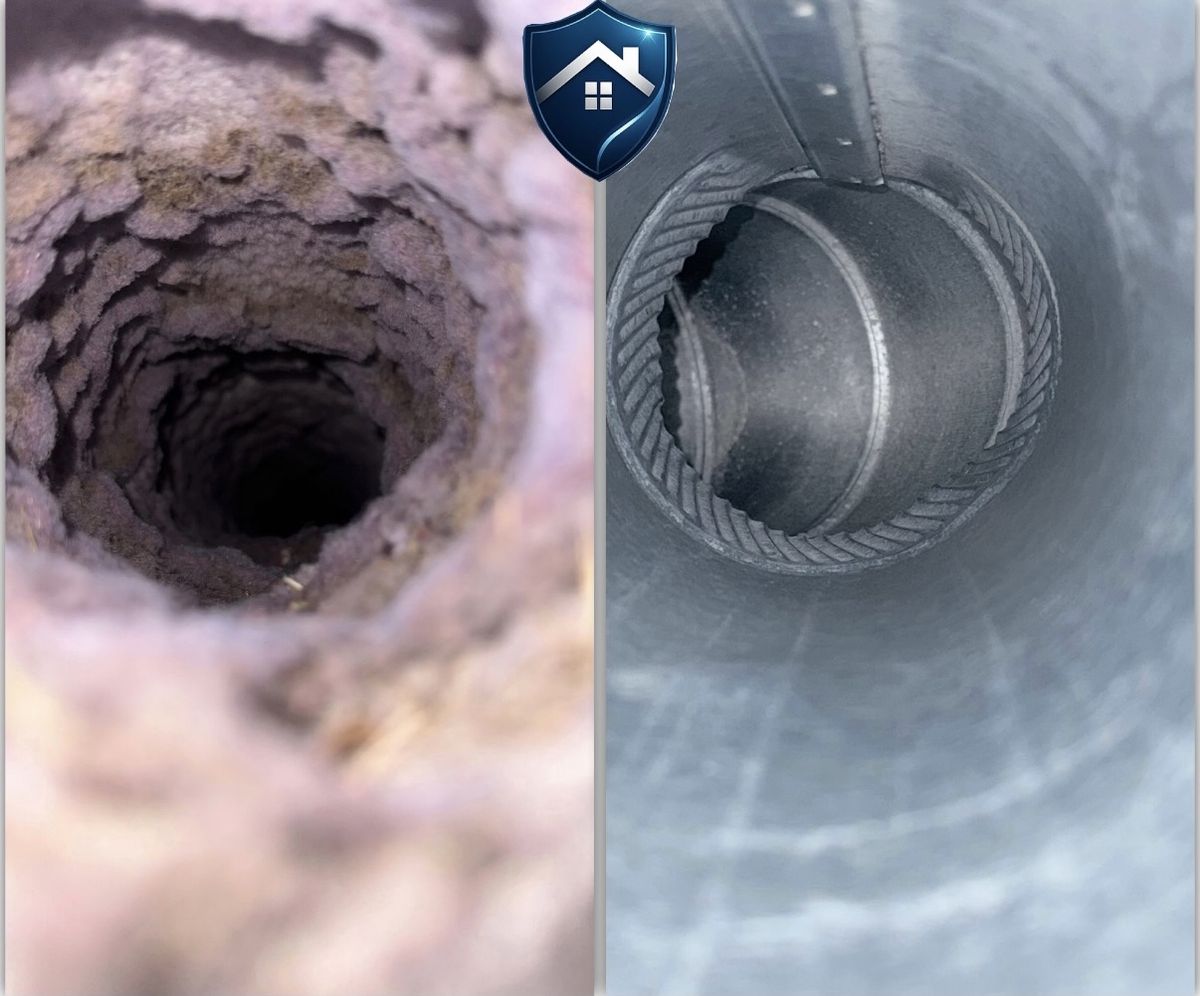
If your dryer used to finish a load in forty minutes and now needs ninety, the machine is almost never the problem. The vent line behind it is. Lint that gets past the trap settles wherever the air slows down, which means the first elbow, the long horizontal run through the attic or crawlspace, and the hood on the outside wall or roof. Once that layer builds up, the dryer cannot push its own heat and moisture out of the house, so it keeps running, the laundry room gets warm and damp, and the drum surface gets hotter than it was designed to be.
We clean dryer vents across Raleigh, from the older ranch houses inside the beltline to the three-story builds in Wakefield, Falls River and Brier Creek. The work is the same everywhere. What differs, and what decides how long the job takes, is where the line runs and where it ends.
What a dryer vent cleaning involves, step by step
- Pull and check the machine. The dryer comes forward far enough to see the transition hose. This is where a surprising share of problems live: a foil or plastic hose crushed flat against the wall, a hose that has slipped off the wall collar, or one so long it has been coiled behind the machine.
- Find where the line goes. We trace the run to its termination, which in Raleigh is usually a hood on an exterior wall, a hood in a soffit, or a cap on the roof. The route decides the method.
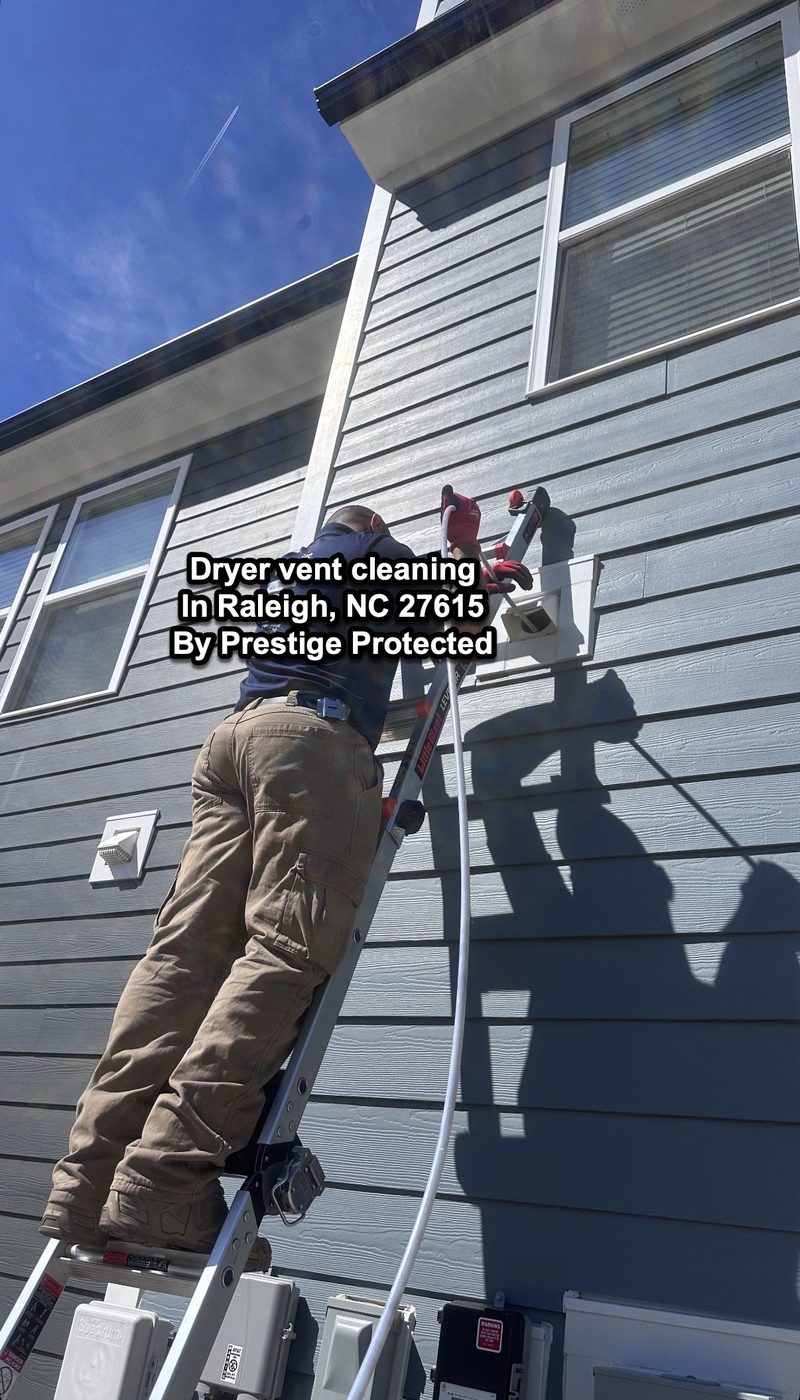
- Brush and vacuum the full length. A rotating brush on flexible rods goes through the duct while a vacuum sits at the open end, so the lint that comes loose leaves the house rather than falling back into the line or blowing into the laundry room.
- Clear the termination and the flap. The exterior hood is the most common blockage point and the one most often skipped. The damper flap has to open freely and close when the dryer stops, or you have an open hole into your house.
- Reconnect properly. Where the transition hose is the weak point, it gets reseated and clamped, or we recommend replacing it with smooth rigid metal.
- Check airflow and show you the result. We run the dryer, check that air is genuinely moving out of the hood, and show you what came out of the line. If the airflow is still poor after a clean line, that is a mechanical problem and we tell you so.
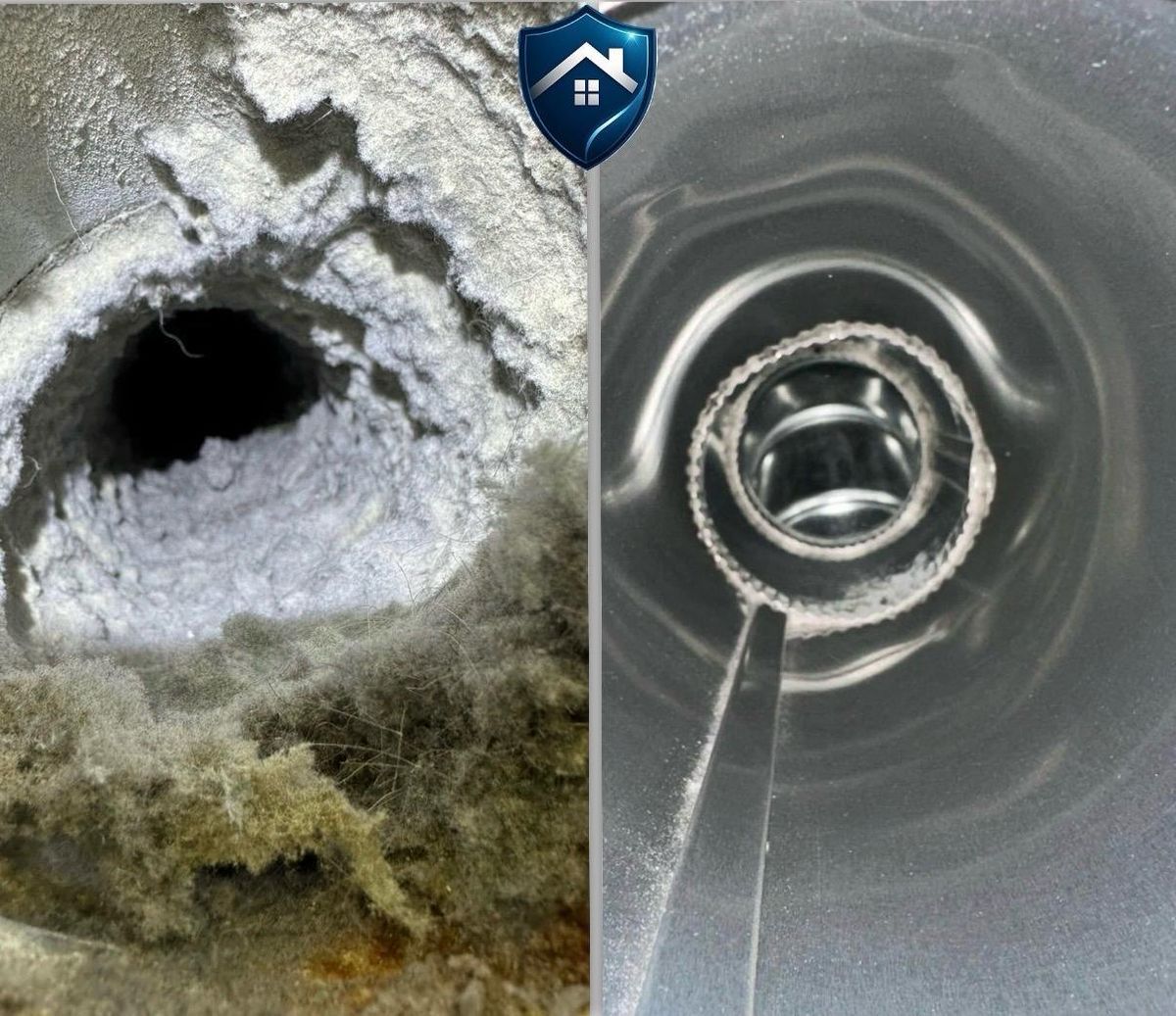
Why do Raleigh dryer vents clog faster than the manual suggests?
Manufacturers write for a short, straight vent. Very few Raleigh houses have one. Five local realities do most of the damage:
- Long runs. In two and three-story builds the laundry room is often upstairs and the nearest exterior wall is not close. A twenty-five foot run with three elbows behaves very differently from the eight-foot run the appliance was tested on. The code puts a number on that. Section M1502.4.5.1 of the 2015 International Residential Code, which the North Carolina Residential Code is built on states: “The maximum length of the exhaust duct shall be 35 feet (10 668 mm) from the connection to the transition duct from the dryer to the outlet terminal.” Table M1502.4.5.1 then charges every fitting against that 35 feet, counting a 4 inch radius mitered 90 degree elbow as 5 feet and a mitered 45 degree elbow as 2 feet 6 inches. A twenty-five foot run with three mitered 90 degree elbows is therefore treated as forty feet, which is already over the limit before a single load has been dried.
- Roof terminations. A vertical line traps lint on the way up, and gravity brings loose lint back down. Roof caps also get the worst of the weather and the wildlife.
- Unconditioned attic and crawlspace runs. Warm wet dryer air moving through a cold attic condenses. Damp lint sticks and packs instead of blowing through, which is why an attic run can go from fine to blocked in one winter.
- Humidity. Raleigh summers are humid enough that the air leaving the dryer is already carrying moisture. Wet lint compacts.
- Birds and pine. Spring nesting in a hood with a broken flap is common here, and pine debris on the roof finds its way into caps that no longer close.
What we usually find, by Raleigh house type
| House type | Typical vent route | What we usually find |
|---|---|---|
| Older single-story inside the beltline | Short run, laundry on an exterior wall | A crushed or kinked transition hose behind the machine, and a painted-shut exterior flap |
| 1980s to 1990s two-story | Downstairs laundry, side wall hood | Lint packed at the first elbow, plus screen mesh someone added to the hood, which the code forbids at a dryer termination |
| Newer three-story (Wakefield, Falls River, Brier Creek) | Upstairs laundry, long run to roof or soffit | Heavy build-up over fifteen to thirty feet, a sagging flex section, sometimes a booster fan nobody knew about |
| Townhouse | Interior laundry closet, vertical chase | Very restricted access, lint at the chase transitions, and a shared wall route that has to be traced |
| Crawlspace laundry | Run through the crawlspace to a rim hood | Damp packed lint, disconnected joints, and rodent damage to flexible sections |
How to tell your Raleigh dryer vent needs cleaning
You do not need a gauge. Time one normal load. A mixed load of everyday clothes should be dry in roughly forty to fifty minutes on a normal heat setting. If it takes two cycles, the vent is the first suspect, not the last. Our two-number test walks through the same check in more detail.
- Clothes come out warm and still damp at the end of a full cycle.
- The laundry room is noticeably hot or humid while the dryer runs.
- A burnt or hot-fabric smell during the cycle. Stop and unplug if you smell this. See dryer overheating and burning smells.
- Little or no air coming out of the exterior hood while the dryer runs. Go outside and check with your hand.
- The exterior flap does not move, or is stuck open and full of lint.
- Lint appearing on the floor around the back of the machine.
- You have never had it cleaned, or you cannot remember when.
The fire risk, in the government’s own numbers
This is the part people either dismiss or oversell, so here is the actual federal figure rather than a sales line.
Failure to clean (31%) was the leading factor contributing to the ignition of clothes dryer fires in homes from 2018-2020.
U.S. Fire Administration, Appliance and Electrical Fire Safety
Dryer fires are not common. But when one happens, the most frequent single contributing factor is a vent nobody cleaned. That 31 percent figure is from the 2018 to 2020 national incident data. A separate and earlier U.S. Fire Administration report, Clothes Dryer Fires in Residential Buildings (2008-2010), gives the scale: “An estimated 2,900 clothes dryer fires in residential buildings are reported to U.S. fire departments each year and cause an estimated 5 deaths, 100 injuries, and $35 million in property loss.” That same report found the risk is seasonal, and that incidence “was higher in the fall and winter months, peaking in January at 11 percent.” Those are national figures across every housing type. The practical takeaway: of everything on that list, the lint is the one factor a homeowner can remove, for the cost of an annual service, and the sensible time to remove it is before winter rather than during it. Our guide to dryer vent fire risk and prevention goes through the mechanism.
What changes the price of a dryer vent cleaning in Raleigh?
We will not print a number on this page that we cannot stand behind for your specific house, because the same service genuinely costs different amounts depending on the run. These are the factors that move it:
- Length of the run. Eight feet to a side wall is a different job from thirty feet to a roof cap.
- Number of elbows. Each turn is another place lint packs and another place the brush has to negotiate.
- Where it terminates. Roof work needs ladder access and takes longer than a hood at waist height.
- Access to the machine. A stacked washer-dryer in a closet has to come apart before anything can be reached.
- Condition of the transition hose. If the flexible hose behind the dryer is torn, crushed or the wrong material, replacing it is a repair on top of the cleaning.
- Whether the line is blocked or merely dirty. A full blockage, a nest or a collapsed section takes real time to clear.
- Number of dryers. Duplexes and in-law suites often have two.
Our dryer vent cleaning cost guide explains how quotes are usually structured and what the very cheap coupon prices tend to leave out. If a price on the phone sounds too good, ask whether it includes clearing the exterior termination, because that is the part most often excluded.
When is cleaning not the answer?
Sometimes we clean a line, the lint comes out, and the dryer still runs long. That means the restriction was never the lint. The usual culprits are a duct that is undersized or partly collapsed, a run that is simply too long for the appliance, a transition hose that is kinked out of sight, a damper that no longer opens, or a vent that was terminated somewhere it should not be, such as into an attic or crawlspace. The U.S. Fire Administration is blunt about that last one, noting that building codes require dryers to be exhausted directly outdoors and that “Venting a dryer into attics, soffits, ridge vents, or crawl spaces is expressly prohibited.” Those are all repairs, and we handle them: see dryer vent repair and replacement in Raleigh, rerouting, and a vent disconnected in the attic.
We would rather tell you on the day that cleaning will not fix it than take the money and let you find out next week.
What we do and do not do
We clean air ducts and dryer vents, repair and replace dryer vent lines, inspect HVAC systems, clean coils, sanitize duct systems, test indoor air quality, run preventative maintenance plans and carry out mold remediation. We do not replace ductwork, we do not sell duct sealing, and we do not repair dryers. If the vent is clear and the appliance is still not drying, you need an appliance technician and we will say so.
If you are comparing companies, our guide on how to choose a duct cleaning company and the one on common scams are written to be useful even if you hire someone else.
Dryer vent cleaning across the Raleigh area
We cover Raleigh and the surrounding towns. Area pages: North Raleigh, West Raleigh, Southwest Raleigh, North Hills, Five Points, Midtown, and by ZIP in 27615, 27609, 27612, 27613, 27614 and 27616. Also Wake Forest, Knightdale, Garner, Rolesville and Durham.
Plenty of Raleigh homes need both jobs on the same visit, and doing them together is cheaper than two trips. Air duct cleaning in Raleigh covers the HVAC side, including what the scope is and when we will tell you it is not worth doing. If the laundry room smells musty rather than hot, mold removal in Raleigh is the page to read.
Frequently asked questions
How often should a dryer vent be cleaned in Raleigh?
Once a year for a typical household. Sooner if you dry more than about five loads a week, if the run is long or goes to the roof, if you have pets that shed heavily, or if drying times have started creeping up. Households with a stacked unit in a closet and a long vertical chase often need it more than once a year. Our schedule guide breaks it down by household size.
How long does a dryer vent cleaning take?
Most Raleigh jobs run between forty five minutes and two hours. A short side-wall run with easy access is at the fast end. A three-story house with an upstairs laundry, a roof cap and a fully blocked line is at the slow end, and a stacked washer-dryer in a closet adds time before the work even starts.
Can I clean my own dryer vent?
You can do the easy parts, and you should. Pull the machine out, vacuum behind it, check the transition hose is not crushed, and clear the exterior hood so the flap moves. What most people cannot do safely is the middle of a long run, anything terminating on a roof, and verifying afterwards that the line is genuinely clear rather than just quieter. Our step-by-step guide covers the DIY portion honestly, including where to stop.
Does a dryer vent cleaning include the outside vent hood?
With us, yes, and you should confirm it with anyone else. The hood and its damper flap are the most common blockage point in Raleigh, and clearing the line without clearing the hood leaves the restriction in place. A cleaning that only reaches in from behind the dryer is half a job.
Why is my dryer still slow after the vent was cleaned?
Because the restriction was not lint. The usual reasons are a duct that is undersized or partly collapsed, a run that is too long for the appliance, a kinked transition hose out of sight behind the machine, a damper that no longer opens, or a heating element or moisture sensor problem in the dryer itself. The first four are vent repairs, which we do. The last one is an appliance repair, which we do not.
Do you clean dryer vents in townhouses and condos with interior laundry closets?
Yes. These are among the most common calls we get in Raleigh, and they are also the ones most likely to need it. An interior closet means a long vertical or horizontal chase, tight access, and no easy way for a homeowner to see what is happening. Where the vent runs through a shared wall we trace the route before starting.
Is a rigid metal transition hose better than the flexible foil kind?
Yes, where it fits. Smooth rigid metal has no ridges for lint to catch on, will not crush, and will not tear. Flexible foil, and especially any plastic or vinyl hose, collects lint in every ridge and crushes flat when the dryer is pushed back against it. If we find plastic or vinyl behind your machine we will recommend replacing it, because that material should not be there at all. See transition hose replacement.
What happens if a dryer vent terminates in the attic or crawlspace?
It has to be fixed rather than cleaned. A dryer moves a large volume of warm moist air, and putting that into an enclosed space causes condensation, then mold, then rot on the framing and insulation. We see it most often where a run was extended during a remodel and never finished. Rerouting it to the outside is a repair, and it is worth doing quickly.
Do you offer same-week dryer vent cleaning appointments in Raleigh?
Usually, yes. Availability varies by week and we will tell you honestly on the phone rather than promise a slot we do not have. If you have a burning smell, stop using the dryer and say so when you call so we can prioritize it.
Should I clean the air ducts at the same time?
Only if there is a reason to. They are separate systems, and a dryer vent cleaning does nothing for your HVAC ducts. The Environmental Protection Agency puts it plainly: “EPA does not recommend that the air ducts be cleaned routinely, but only as needed.” It names three conditions where you should consider it: substantial visible mold growth inside hard surface ducts or on other components of the system, ducts infested with vermin such as rodents or insects, and ducts clogged with excessive amounts of dust and debris where particles are actually released into the home from the supply registers. If you are seeing any of those, our Raleigh air duct cleaning page explains what we look for.
Related reading
- Raleigh 27610 (southeast Raleigh)
- Raleigh 27617 (Brier Creek and RDU)
- Rental turnover cleaning in Raleigh
Book a dryer vent cleaning in Raleigh
We brush and vacuum the whole line, clear the exterior hood and its flap, check the airflow afterwards and show you what came out. If cleaning will not fix your drying times, we tell you that on the day.
Last updated by the Prestige Protected service team.